
Self-sanitizing Plastics Market Growth, Size, Trends ,Analysis and Segment Forecast to 2034

Global Self-sanitizing Plastics Market Growth, Size, Trends Analysis- By Product, By Application - Regional Outlook, Competitive Strategies and Segment Forecast to 2034

Published: Nov-2025 Report ID: CHEM25194 Pages: 1 - 244 Formats*:     
Category : Chemical & Materials
Self-sanitizing Plastics Market Introduction and Overview 

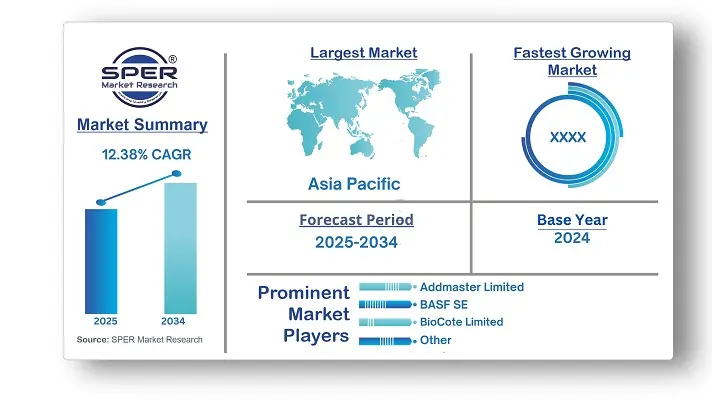
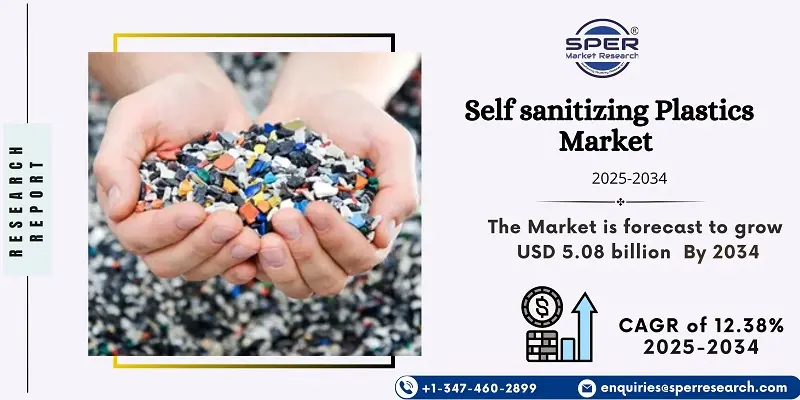
According to SPER Market Research, the Global Self-sanitizing Plastics Market is estimated to reach USD 5.08 billion by 2034 with a CAGR 12.38%.

The report includes an in-depth analysis of the Global Self-sanitizing Plastics Market, including market size and trends, product mix, Applications, and supplier analysis. The global Self-sanitizing Plastics Market was valued at USD 1.58 billion in 2024 and is expected to grow at a CAGR of over 12.38% from 2025 to 2034. Rising awareness of hygiene and infection prevention, accelerated by the COVID-19 pandemic, is driving the growth of the self-sanitizing plastics market. Both consumers and industries are seeking solutions that minimize microbial contamination. In healthcare, antimicrobial plastics are widely used in medical devices, surgical instruments, hospital equipment, and high-touch surfaces to reduce infection risks. In packaging, they are increasingly applied to food, beverage, and pharmaceutical products to enhance safety and shelf life, supported by strict regulatory standards. Technological advances, including antimicrobial additives, coatings, and the integration of silver, copper, and other agents, are enhancing durability and long-lasting pathogen protection.
By Product:
The antimicrobial additives segment holds the largest market share and is expected to grow rapidly. These additives, including silver, copper, zinc, and organic compounds, are incorporated into plastics during manufacturing to prevent the growth of bacteria, viruses, and fungi. Their cost-effectiveness, ease of integration, and versatility make them popular across healthcare, packaging, and consumer goods. Antimicrobial coatings provide surface-level protection, creating a barrier against microbes. Widely used on medical devices, hospital equipment, and packaging, these coatings help reduce infection risks and contamination, driving strong demand across multiple industries.

By Application:
The automotive segment leads the market, with growing adoption of self-sanitizing plastics to improve passenger hygiene and safety, especially after COVID-19. These materials are used in high-touch interior parts like door handles, steering wheels, gear shifts, and dashboards, reducing microbial contamination and supporting safer shared mobility. In healthcare, self-sanitizing plastics are widely applied in medical devices, hospital equipment, surgical instruments, and high-touch surfaces such as bed rails and IV poles. Their antimicrobial properties help minimize healthcare-associated infections, and the pandemic has accelerated their use to strengthen infection control measures.

Regional Insights:
North America’s self-sanitizing plastics market emphasizes sustainability and innovation, driving the development of eco-friendly antimicrobial plastics. While high production costs and regulatory hurdles pose challenges, technological advancements and strong industry demand help maintain its leadership. In the U.S., a robust healthcare system, advanced packaging industry, and high consumer hygiene awareness drive adoption, with antimicrobial plastics used in medical devices, hospital equipment, and food and pharmaceutical packaging. Asia Pacific leads globally, driven by countries like China, India, and Japan, supported by a large population, growing middle class, healthcare and packaging demand, and government initiatives promoting public health and food safety.


Market Competitive Landscape:
The Self-sanitizing Plastics Market is highly consolidated. Some of the market key players are Addmaster Limited, BASF SE, BioCote Limited, DuPont, King Plastic Corporation, Lonza Group, Milliken & Company, Microban International, Parx Plastics, Polychem Alloy Inc.

Recent Developments:
In February 2022, RMIT University in Australia launched self-sanitizing bioplastics designed to repel liquids and dirt. Made from cost-effective and widely accessible materials like starch and cellulose, these bioplastics offer low production costs and rapid biodegradability. They are particularly suited for fresh food and takeaway packaging applications.

Scope of the report:
 Report Metric Details
Market size available for years 2021-2034
Base year considered 2024
 Forecast period 2025-2034
Segments coveredBy Product, By Application
Regions covered
North America, Latin America, Asia-Pacific, Europe, and Middle East & Africa
Companies Covered
Addmaster Limited, BASF SE, BioCote Limited, DuPont, King Plastic Corporation, Lonza Group, Milliken & Company, Microban International, Parx Plastics, Polychem Alloy Inc.
Key Topics Covered in the Report
  • Global Self-sanitizing Plastics Market Size (FY’2021-FY’2034)
  • Overview of Global Self-sanitizing Plastics Market
  • Segmentation of Global Self-sanitizing Plastics Market By Product (Antimicrobial Additives, Coatings, Inherently Antimicrobial Plastics, Other Products)
  • Segmentation of Global Self-sanitizing Plastics Market By Application (Automotive, Healthcare, Packaging, Consumer Goods, Building & Construction, Other Applications)
  • Statistical Snap of Global Self-sanitizing Plastics Market
  • Expansion Analysis of Global Self-sanitizing Plastics Market
  • Problems and Obstacles in Global Self-sanitizing Plastics Market
  • Competitive Landscape in the Global Self-sanitizing Plastics Market
  • Details on Current Investment in Global Self-sanitizing Plastics Market
  • Competitive Analysis of Global Self-sanitizing Plastics Market
  • Prominent Players in the Global Self-sanitizing Plastics Market
  • SWOT Analysis of Global Self-sanitizing Plastics Market
  • Global Self-sanitizing Plastics Market Future Outlook and Projections (FY’2025-FY’2034)
  • Recommendations from Analyst


1.Introduction
1.1.Scope of the report
1.2.Market segment analysis 

2.Research Methodology
2.1.Research data source
2.1.1.Secondary Data
2.1.2.Primary Data
2.1.3.SPERs internal database
2.1.4.Premium insight from KOLs
2.2.Market size estimation
2.2.1.Top-down and Bottom-up approach
2.3.Data triangulation

3.Executive Summary

4.Market Dynamics
4.1.Driver, Restraint, Opportunity and Challenges analysis
4.1.1.Drivers
4.1.2.Restraints
4.1.3.Opportunities
4.1.4.Challenges

5.Market variable and outlook
5.1.SWOT Analysis
5.1.1.Strengths
5.1.2.Weaknesses
5.1.3.Opportunities
5.1.4.Threats
5.2.PESTEL Analysis
5.2.1.Political Landscape
5.2.2.Economic Landscape
5.2.3.Social Landscape
5.2.4.Technological Landscape
5.2.5.Environmental Landscape
5.2.6.Legal Landscape
5.3.PORTERs Five Forces 
5.3.1.Bargaining power of suppliers
5.3.2.Bargaining power of buyers
5.3.3.Threat of Substitute
5.3.4.Threat of new entrant
5.3.5.Competitive rivalry
5.4.Heat Map Analysis

6.Competitive Landscape
6.1.Global Self-sanitizing Plastics Market Manufacturing Base Distribution, Sales Area, Product Type 
6.2.Mergers & Acquisitions, Partnerships, Product Launch, and Collaboration in Global Self-sanitizing Plastics Market

7.Global Self-sanitizing Plastics Market, By Product, (USD Million) 2021-2034 
7.1.Antimicrobial Additives
7.2.Coatings
7.3.Inherently Antimicrobial Plastics
7.4.Other Products

8.Global Self-sanitizing Plastics Market, By Application, (USD Million) 2021-2034 
8.1.Automotive
8.2.Healthcare
8.3.Packaging
8.4.Consumer Goods
8.5.Building & Construction
8.6.Other Applications

9.Global Self-sanitizing Plastics Market, (USD Million) 2021-2034 
9.1.Global Self-sanitizing Plastics Market Size and Market Share

10.Global Self-sanitizing Plastics Market, By Region, 2021-2034 (USD Million)
10.1.Asia-Pacific
10.1.1.Australia
10.1.2.China
10.1.3.India
10.1.4.Japan
10.1.5.South Korea
10.1.6.Rest of Asia-Pacific
10.2.Europe
10.2.1.France
10.2.2.Germany
10.2.3.Italy
10.2.4.Spain
10.2.5.United Kingdom
10.2.6.Rest of Europe
10.3.Middle East and Africa
10.3.1.Kingdom of Saudi Arabia 
10.3.2.United Arab Emirates
10.3.3.Qatar
10.3.4.South Africa
10.3.5.Egypt
10.3.6.Morocco
10.3.7.Nigeria
10.3.8.Rest of Middle-East and Africa
10.4.North America
10.4.1.Canada
10.4.2.Mexico
10.4.3.United States
10.5.Latin America
10.5.1.Argentina
10.5.2.Brazil
10.5.3.Rest of Latin America 

11.Company Profile
11.1.Addmaster Limited
11.1.1.Company details
11.1.2.Financial outlook
11.1.3.Product summary 
11.1.4.Recent developments
11.2.BASF SE
11.2.1.Company details
11.2.2.Financial outlook
11.2.3.Product summary 
11.2.4.Recent developments
11.3.BioCote Limited
11.3.1.Company details
11.3.2.Financial outlook
11.3.3.Product summary 
11.3.4.Recent developments
11.4.DuPont
11.4.1.Company details
11.4.2.Financial outlook
11.4.3.Product summary 
11.4.4.Recent developments
11.5.King Plastic Corporation
11.5.1.Company details
11.5.2.Financial outlook
11.5.3.Product summary 
11.5.4.Recent developments
11.6.Lonza Group
11.6.1.Company details
11.6.2.Financial outlook
11.6.3.Product summary 
11.6.4.Recent developments
11.7.Milliken & Company
11.7.1.Company details
11.7.2.Financial outlook
11.7.3.Product summary 
11.7.4.Recent developments
11.8.Microban International
11.8.1.Company details
11.8.2.Financial outlook
11.8.3.Product summary 
11.8.4.Recent developments
11.9.Parx Plastics
11.9.1.Company details
11.9.2.Financial outlook
11.9.3.Product summary 
11.9.4.Recent developments
11.10.Polychem Alloy Inc.
11.10.1.Company details
11.10.2.Financial outlook
11.10.3.Product summary 
11.10.4.Recent developments
11.11.Others

12.Conclusion

13.List of Abbreviations

14.Reference Links

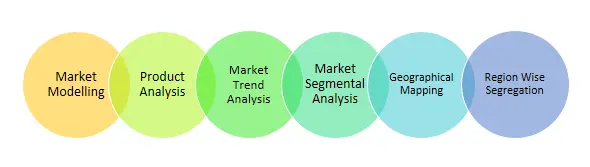
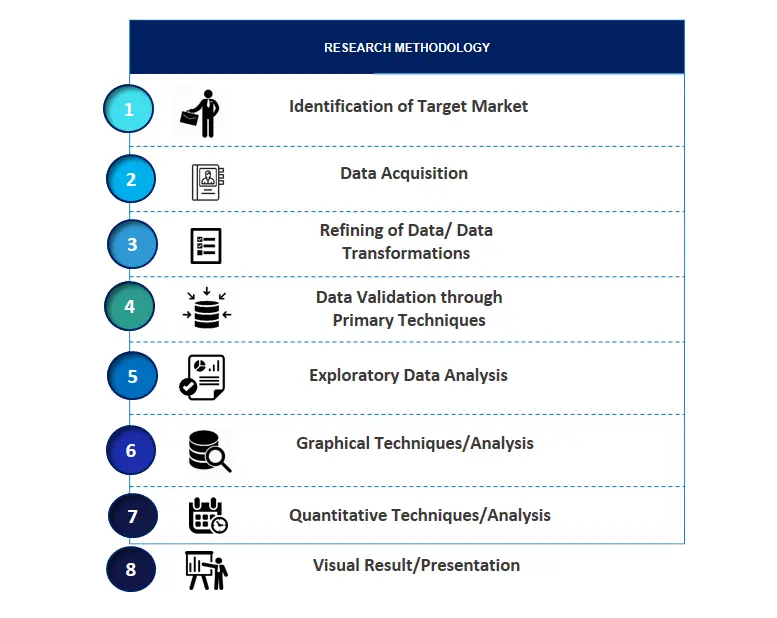
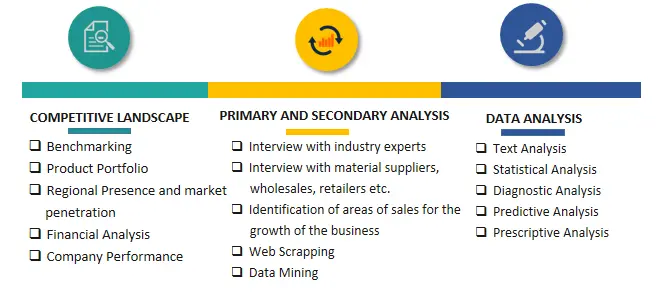
SPER Market Research’s methodology uses great emphasis on primary research to ensure that the market intelligence insights are up to date, reliable and accurate. Primary interviews are done with players involved in each phase of a supply chain to analyze the market forecasting. The secondary research method is used to help you fully understand how the future markets and the spending patterns look likes.

The report is based on in-depth qualitative and quantitative analysis of the Product Market. The quantitative analysis involves the application of various projection and sampling techniques. The qualitative analysis involves primary interviews, surveys, and vendor briefings.  The data gathered as a result of these processes are validated through experts opinion. Our research methodology entails an ideal mixture of primary and secondary initiatives.
SPER-Methodology-1

SPER-Methodology-2

SPER-Methodology-3


Frequently Asked Questions About This Report
Self-sanitizing Plastics Market is projected to reach USD 5.08 by 2034, growing at a CAGR of 12.38% during the forecast period.
Self-sanitizing Plastics Market size from 2025. The Market is expected to reach USD 5.08 by 2034, at a CAGR of 12.38% during the forecast period.
Self-sanitizing Plastics Market CAGR of 12.38% during the forecast period.
Self-sanitizing Plastics Market size is USD 5.08 from 2025 to 2034.
Self-sanitizing Plastics Market covered By Product, By Application
The North America is anticipated to have the highest Market share in the Self-sanitizing Plastics Market .
"Addmaster Limited, BASF SE, BioCote Limited, DuPont, King Plastic Corporation, Lonza Group, Milliken & Company, Microban International, Parx Plastics, Polychem Alloy Inc. "
" The report includes an in-depth analysis of the Global Self-sanitizing Plastics Market, including market size and trends, product mix, Applications, and supplier analysis."
PLACE AN ORDER
  • 15 % off
     
    $ 4250
  • 20 % off
             
    $ 5650
  • 25 % off
         
    $ 7450
Pre-Purchase Inquiry
SEND AN INQUIRY
NEED CUSTOMIZATION?
Request Customization
CALL OR EMAIL US
US:
India:
Email:
100% Secure Payment

SPER American Express
SPER VISA
SPER Master Card
SPER Mestro
SPER Paypal
SPER CCAvenues

Have a glance of the Report

  Download Free Sample

Looking for Customization?

 Customization Request

Have a Question?

 Reach Our Analysis Team

COVID-19 impact analysis?

 Request Analysis

Our Global Clients

Our data-driven insights have influenced the strategy of 200+ reputed companies across the globe.


SPER-Astellas Pharma
SPER-Microsoft
SPER-EY
SPER-McKinsey
SPER-Bain
SPER-Max-Healthcare
SPER-DHL
SPER-IQVIA
SPER-Mitsubishi Logistics
SPER-PACCOR
SPER-Macmillan Education
SPER-Kankar IMRB
SPER-ITA
SPER-PWC
SPER-SAPTCA
SPER-Straumann
SPER-Danaher
SPER-AandM
SPER-MENARINI Silicon Biosystems
SPER-IPSOS
SPER-Heineken