Global Sustainable Adhesives for Packaging Market Report

Global Sustainable Adhesives for Packaging Market Growth, Size, Trends Analysis- By Adhesive Type, By Packaging Type, By End Use– Regional Outlook, Competitive Strategies and Segment Forecast to 2034

Published: Jan-2026 Report ID: PACK2606 Pages: 1 - 122 Formats*:     
Category : Packaging
Introduction and Overview
The report includes an in-depth analysis of the Global Sustainable Adhesives for Packaging Market, including market size and trends, product mix, Applications, and supplier analysis.

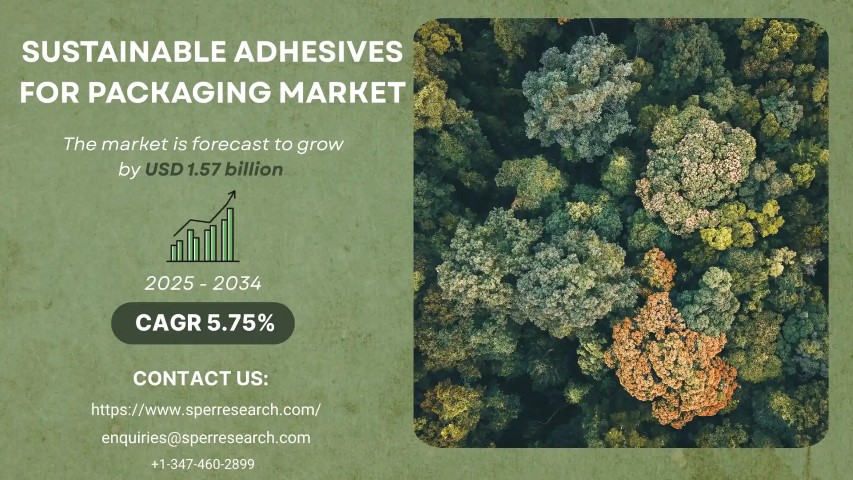
The global Sustainable Adhesives for Packaging Market was valued at USD 1.57 billion in 2024 and is expected to grow at a CAGR of approximately 5.75% from 2025 to 2034, supported by tightening environmental standards and increasing awareness around sustainable packaging solutions. This growth reflects the shift from conventional solvent-based adhesives to eco-friendly formulations that meet stringent regional regulatory mandates and corporate sustainability goals. Rising environmental concerns and consumer preference for recyclable and biodegradable packaging materials are encouraging adoption across food & beverage, e-commerce, and personal care sectors. Expansion of worldwide e-commerce and pressure to reduce plastic waste are further accelerating demand for sustainable adhesive technologies.

By Adhesive Type:
By adhesive type, bio-based adhesives account for a significant share of the sustainable adhesives for packaging market. These adhesives are derived from renewable resources such as plant starches and natural resins, making them well aligned with sustainability objectives and regulatory requirements. They provide reliable bonding performance while reducing environmental impact compared to conventional formulations. Growing regulatory pressure to limit VOC emissions and increasing brand focus on renewable materials are supporting wider adoption. In addition, ongoing advancements in bio-based chemistry are improving performance characteristics, enabling their use across a broad range of packaging applications.

By Packaging Type:
By packaging type, flexible packaging represents the largest share of demand for sustainable adhesives. Flexible packaging is extensively used across food & beverage, consumer goods, and fast-moving packaged products due to its lightweight nature and material efficiency. Adhesives used in this segment must ensure strong bonding for multi-layer structures while supporting recyclability and sustainability goals. The growing preference for lightweight packaging, reduced material usage, and compatibility with eco-friendly substrates continues to reinforce the importance of flexible packaging within the overall market.

By End-Use Industry:
By end-use industry, the food & beverage sector accounts for the largest portion of demand for sustainable adhesives in packaging. This is driven by the need to ensure product safety, hygiene, and regulatory compliance while meeting sustainability targets. Eco-friendly adhesives are widely used in food packaging formats to support recyclable and biodegradable materials without compromising performance. Rising consumer awareness regarding sustainable food packaging and stricter environmental regulations are further encouraging adoption, making food and beverage packaging a key contributor to overall market growth.

Regional Insights:
The sustainable adhesives for packaging market exhibits varied regional dynamics influenced by regulation, industrial growth, and consumer awareness. North America, led by the U.S. and Canada, benefits from advanced packaging technologies and strong environmental regulations promoting low-VOC adhesives. Europe, including Germany, the UK, France, Spain, Italy, and the Netherlands, is driven by strict sustainability mandates and high adoption of recyclable packaging solutions. Asia Pacific, with China, India, Japan, Australia, and South Korea, is supported by rapid industrialization, expanding e-commerce, and rising sustainability focus. Latin America shows steady progress, while the Middle East and Africa witness gradual adoption with retail and infrastructure growth.

Market Competitive Landscape:
The Sustainable Adhesives for Packaging Market is highly consolidated. Some of the market key players are 3M, Arkema (Bostik), Ashland, Avery Dennison Corporation, BASF SE, DIC Corporation, Dow, H.B. Fuller Company, Henkel AG & Co. KGaA, Jowat SE, Paramelt, Sika AG, Toyo Ink SC Holdings, UPM Raflatac

Recent Developments:
In June 2023, Arkema launched Sartomer Ecosphere bio-based tenacious for sustainable food packaging. The new result, made from 90 renewable factory- grounded content, provides original performance to traditional petroleum- grounded bonds with a 50 reduction in carbon emigrations. The product has formerly been enforced by leading European food companies for flexible packaging of dry foods and firmed foods. Arkema's development follows the EU's Single- Use Plastics Directive, targeting adding demand for compostable packaging. The establishment has invested Euro 30 million at its Mont, France factory to expand product, with capacity prognosticated to hit 50,000 tons per annum by 2025.

In May 2024, Avery Dennison Corp. introduced a new point in its CleanFlake technology, a displacing point, allowing homemade junking of markers from PET substrates within an eight- hour window. leanFlake glue has revolutionized plastic packaging recycling and entered recognition from the Association of Plastic Recyclers (APR) for enhancing PET by fairly removing markers during recycling and allowing HDPE mono- material recycling without hindrance.


Scope of the report:
Report MetricDetails
Market size available for years2021-2034
Base year considered2024
Forecast period2025-2034
Segments coveredBy Adhesive Type, By End-Use Industry, By End-Use Industry
Regions coveredAsia-Pacific
Companies Covered3M, Arkema (Bostik), Ashland, Avery Dennison Corporation, BASF SE, DIC Corporation, Dow, H.B. Fuller Company, Henkel AG & Co. KGaA, Jowat SE, Paramelt, Sika AG, Toyo Ink SC Holdings, UPM Raflatac

Key Topics Covered in the Report
  • Global Sustainable Adhesives for Packaging Market Size (FY’2021-FY’2034)
  • Overview of Global SustainableAdhesives for Packaging Market 
  • Segmentation of GlobalSustainable Adhesives for Packaging Market by Adhesive Type (Bio-basedadhesives, Water-based adhesives, Solvent-free adhesives, Hot-melt adhesives,Others)
  • Segmentation of GlobalSustainable Adhesives for Packaging Market by Packaging Type (Flexiblepackaging, Rigid packaging, Labels & tapes)
  • Segmentation of GlobalSustainable Adhesives for Packaging Market by End Use (Food & beverage,Personal care & cosmetics, Pharmaceuticals, E-commerce & retail,Others)
  • Statistical Snap of GlobalSustainable Adhesives for Packaging Market 
  • Expansion Analysis of GlobalSustainable Adhesives for Packaging Market 
  • Problems and Obstacles inGlobal Sustainable Adhesives for Packaging Market 
  • Competitive Landscape in theGlobal Sustainable Adhesives for Packaging Market 
  • Details on Current Investmentin Global Sustainable Adhesives for Packaging Market 
  • Competitive Analysis of GlobalSustainable Adhesives for Packaging Market 
  • Prominent Players in the GlobalSustainable Adhesives for Packaging Market 
  • SWOT Analysis of GlobalSustainable Adhesives for Packaging Market 
  • Global Sustainable Adhesivesfor Packaging Market Future Outlook and Projections (FY’2025-FY’2034)
  • Recommendations from Analyst
1.Introduction
1.1. Scope of the report
1.2. Market segment analysis 

2.Research Methodology
2.1. Research data source
2.1.1. Secondary Data
2.1.2. Primary Data
2.1.3. SPER’s internal database
2.1.4. Premium insight from KOL’s
2.2. Market size estimation
2.2.1. Top-down and Bottom-up approach
2.3. Data triangulation

3.Executive Summary

4.Market Dynamics
4.1. Driver, Restraint, Opportunity and Challenges analysis
4.1.1. Drivers
4.1.2. Restraints
4.1.3. Opportunities
4.1.4. Challenges

5.Market variable and outlook
5.1. SWOT Analysis
5.1.1. Strengths
5.1.2. Weaknesses
5.1.3. Opportunities
5.1.4. Threats
5.2. PESTEL Analysis
5.2.1. Political Landscape
5.2.2. Economic Landscape
5.2.3. Social Landscape
5.2.4. Technological Landscape
5.2.5. Environmental Landscape
5.2.6. Legal Landscape
5.3. PORTER’s Five Forces 
5.3.1. Bargaining power of suppliers
5.3.2. Bargaining power of buyers
5.3.3. Threat of Substitute
5.3.4. Threat of new entrant
5.3.5. Competitive rivalry
5.4. Heat Map Analysis

6.Competitive Landscape
6.1. Global Sustainable Adhesives for Packaging Market Manufacturing Base Distribution, Sales Area, Product Type 
6.2. Mergers & Acquisitions, Partnerships, Product Launch, and Collaboration in Global Sustainable Adhesives for Packaging Market

7.Global Sustainable Adhesives for Packaging Market, By Adhesive Type, (USD Million) 2021-2034 
7.1. Bio-based adhesives
7.2. Water-based adhesives
7.3. Solvent-free adhesives
7.4. Hot-melt adhesives
7.5. Others

8.Global Sustainable Adhesives for Packaging Market, By Packaging Type, (USD Million) 2021-2034 
8.1. Flexible packaging
8.2. Rigid packaging
8.3. Labels & tapes

9.Global Sustainable Adhesives for Packaging Market, By End Use, (USD Million) 2021-2034 
9.1. Food & beverage
9.2. Personal care & cosmetics
9.3. Pharmaceuticals
9.4. E-commerce & retail
9.5. Others

10.Global Sustainable Adhesives for Packaging Market, (USD Million) 2021-2034 
10.1. Global Sustainable Adhesives for Packaging Market Size and Market Share

11.Global Sustainable Adhesives for Packaging Market, By Region, 2021-2034 (USD Million)
11.1. Asia-Pacific
11.1.1. Australia
11.1.2. China
11.1.3. India
11.1.4. Japan
11.1.5. South Korea
11.1.6. Rest of Asia-Pacific
11.2. Europe
11.2.1. France
11.2.2. Germany
11.2.3. Italy
11.2.4. Spain
11.2.5. United Kingdom
11.2.6. Rest of Europe
11.3. Middle East and Africa
11.3.1. Kingdom of Saudi Arabia 
11.3.2. United Arab Emirates
11.3.3. Qatar
11.3.4. South Africa
11.3.5. Egypt
11.3.6. Morocco
11.3.7. Nigeria
11.3.8. Rest of Middle-East and Africa
11.4. North America
11.4.1. Canada
11.4.2. Mexico
11.4.3. United States
11.5. Latin America
11.5.1. Argentina
11.5.2. Brazil
11.5.3. Rest of Latin America 

12.Company Profile
12.1. 3M
12.1.1. Company details
12.1.2. Financial outlook
12.1.3. Product summary 
12.1.4. Recent developments
12.2. Arkema (Bostik)
12.2.1. Company details
12.2.2. Financial outlook
12.2.3. Product summary 
12.2.4. Recent developments
12.3. Ashland, Avery Dennison Corporation
12.3.1. Company details
12.3.2. Financial outlook
12.3.3. Product summary 
12.3.4. Recent developments
12.4. BASF SE
12.4.1. Company details
12.4.2. Financial outlook
12.4.3. Product summary 
12.4.4. Recent developments
12.5. DIC Corporation
12.5.1. Company details
12.5.2. Financial outlook
12.5.3. Product summary 
12.5.4. Recent developments
12.6. Dow
12.6.1. Company details
12.6.2. Financial outlook
12.6.3. Product summary 
12.6.4. Recent developments
12.7. H.B. Fuller Company
12.7.1. Company details
12.7.2. Financial outlook
12.7.3. Product summary 
12.7.4. Recent developments
12.8. Henkel AG & Co. KGaA
12.8.1. Company details
12.8.2. Financial outlook
12.8.3. Product summary 
12.8.4. Recent developments
12.9. Jowat SE
12.9.1. Company details
12.9.2. Financial outlook
12.9.3. Product summary 
12.9.4. Recent developments
12.10. Paramelt
12.10.1. Company details
12.10.2. Financial outlook
12.10.3. Product summary 
12.10.4. Recent developments
12.11. Sika AG
12.11.1. Company details
12.11.2. Financial outlook
12.11.3. Product summary 
12.11.4. Recent developments
12.12. Toyo Ink SC Holdings
12.12.1. Company details
12.12.2. Financial outlook
12.12.3. Product summary 
12.12.4. Recent developments
12.13. UPM Raflatac
12.13.1. Company details
12.13.2. Financial outlook
12.13.3. Product summary 
12.13.4. Recent developments

13. Conclusion

14. List of Abbreviations

15. Reference Links

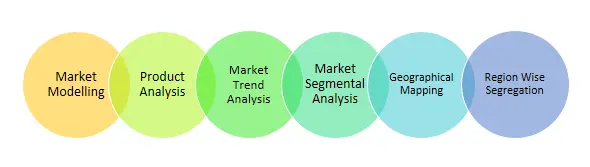
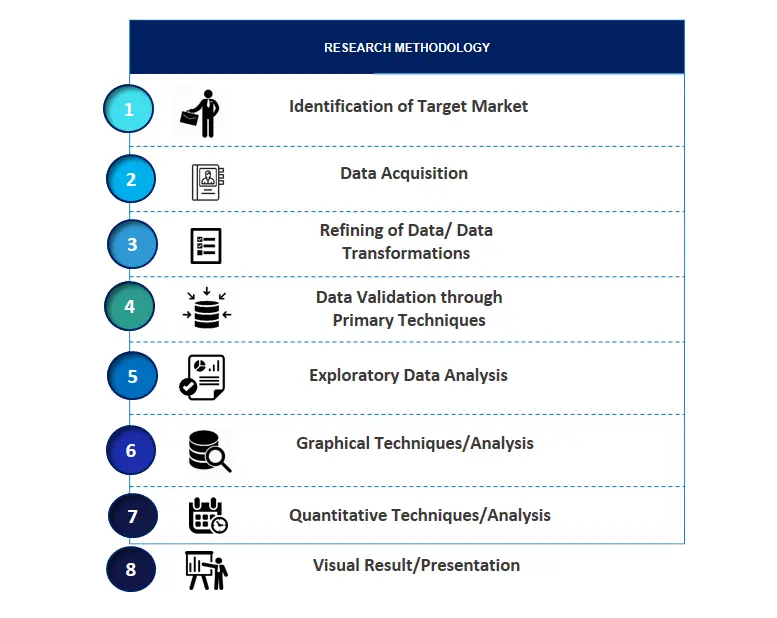
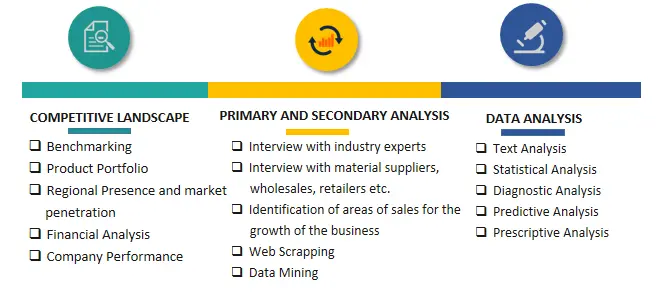
SPER Market Research’s methodology uses great emphasis on primary research to ensure that the market intelligence insights are up to date, reliable and accurate. Primary interviews are done with players involved in each phase of a supply chain to analyze the market forecasting. The secondary research method is used to help you fully understand how the future markets and the spending patterns look likes.

The report is based on in-depth qualitative and quantitative analysis of the Product Market. The quantitative analysis involves the application of various projection and sampling techniques. The qualitative analysis involves primary interviews, surveys, and vendor briefings.  The data gathered as a result of these processes are validated through experts opinion. Our research methodology entails an ideal mixture of primary and secondary initiatives.
SPER-Methodology-1

SPER-Methodology-2

SPER-Methodology-3


Frequently Asked Questions About This Report
Sustainable adhesives are formulated with eco-friendly materials that reduce environmental impact, unlike conventional solvent-based adhesives that often release harmful emissions. They are designed to meet strict regulatory standards while supporting recyclability and biodegradability in packaging.
The demand is rising due to growing environmental concerns, consumer preference for green packaging, and government regulations aimed at reducing plastic waste. Companies are also adopting sustainable adhesives to align with corporate sustainability goals and improve brand reputation.
Food & beverage, e-commerce, and personal care are the leading sectors. These industries require reliable, safe, and eco-friendly packaging solutions to meet consumer expectations, comply with recycling mandates, and handle high packaging volumes efficiently.
PLACE AN ORDER
  • 15 % off
     
    $ 4250
  • 20 % off
             
    $ 5650
  • 25 % off
         
    $ 7450
Pre-Purchase Inquiry
SEND AN INQUIRY
NEED CUSTOMIZATION?
Request Customization
CALL OR EMAIL US
US:
India:
Email:
100% Secure Payment

SPER American Express
SPER VISA
SPER Master Card
SPER Mestro
SPER Paypal
SPER CCAvenues

Have a glance of the Report

  Download Free Sample

Looking for Customization?

 Customization Request

Have a Question?

 Reach Our Analysis Team

COVID-19 impact analysis?

 Request Analysis
Thought Leadership

Trusted by Industry Leaders

Our data-driven insights have influenced the strategy of 200+ reputed companies across the globe.

SPER-Astellas Pharma
SPER-Microsoft
SPER-EY
SPER-McKinsey
SPER-Bain
SPER-Max-Healthcare
SPER-DHL
SPER-IQVIA
SPER-Mitsubishi Logistics
SPER-PACCOR
SPER-Macmillan Education
SPER-Kankar IMRB
SPER-ITA
SPER-PWC
SPER-SAPTCA
SPER-Straumann
SPER-Danaher
SPER-AandM
SPER-MENARINI Silicon Biosystems
SPER-IPSOS
SPER-Heineken
HIPPA Compliant
GDPR Certified
ISO 27001
Peer Reviewed
Get Started Today

Your Competitive Advantage in
Pharmaceutical & Medical Technology
Markets

Join industry leaders leveraging AI-powered intelligence to make confident, data-driven decisions that accelerate breakthrough treatments and technologies to market.

No Credit Card Required
15-Minute Demo
Expert Guidance