AI in Agriculture Market Growth Forecast

Global AI in Agriculture Market Growth, Size, Trends Analysis -By Component, By Technology, By Application, By Deployment Mode, By Farm Size –Regional Outlook, Competitive Strategies and Segment Forecast to 2034

Published: Jan-2026 Report ID: AGRI2601 Pages: 1 - 139 Formats*:     
Category : Agriculture
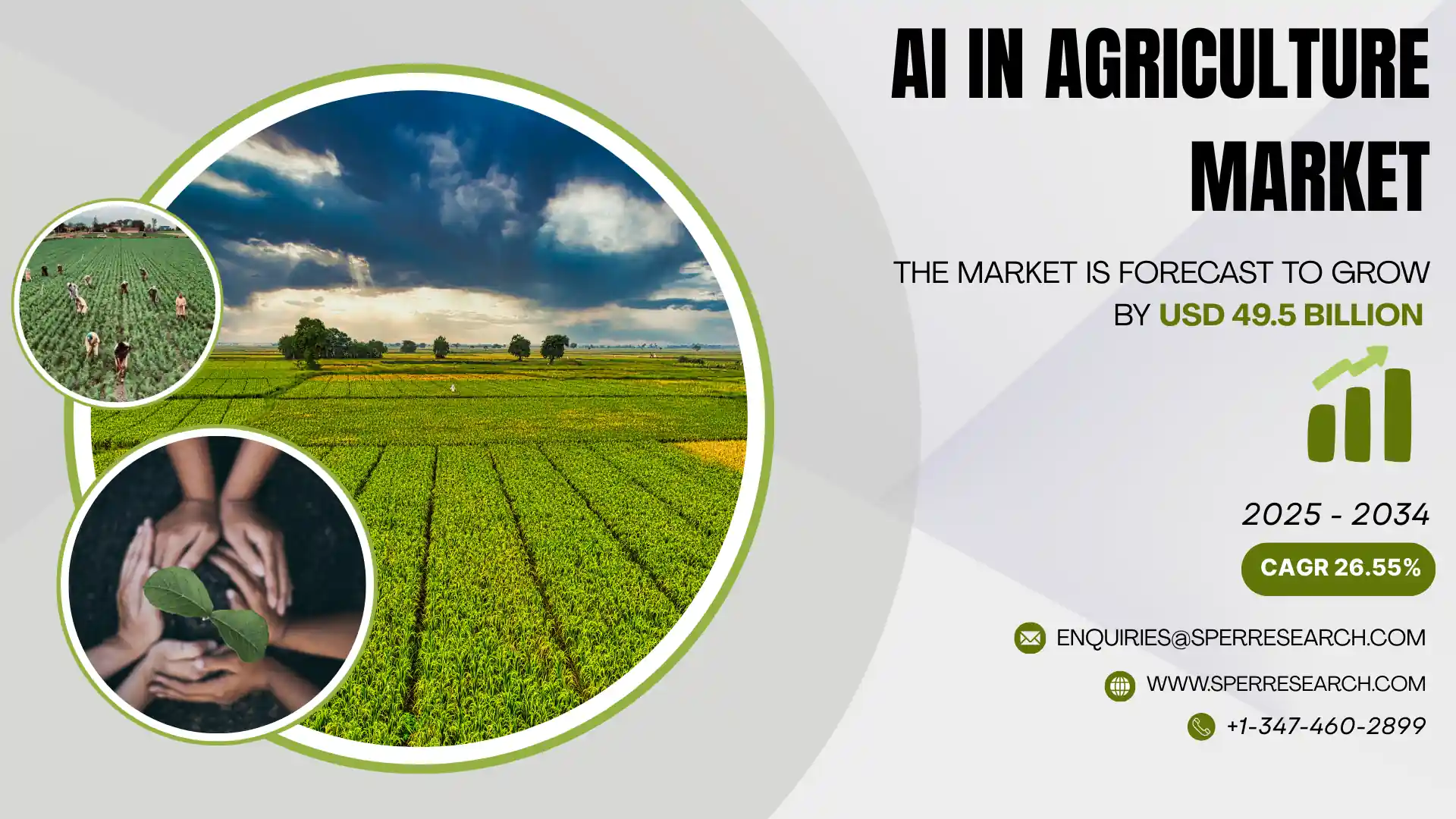
According to SPER Market Research, the Global AI in Agriculture Market is estimated to reach USD 49.51 billion by 2034 with a CAGR 26.55%.

Introduction and Overview

The report includes an in-depth analysis of the Global AI in Agriculture Market, including market size and trends, product mix, Applications, and supplier analysis.

The global AI in Agriculture Market was valued at approximately USD 4.7 billion in 2024 and is expected to grow at a CAGR of around 26.55% from 2025 to 2034, driven by expanding adoption of artificial intelligence technologies across farming operations. This growth is fueled by the integration of AI with precision farming tools, real-time data analytics, and cloud platforms that help optimize crop yields, automate tasks, and enhance resource efficiency. Rising demand for data-driven decision-making, labor shortages prompting automation, and supportive government initiatives accelerate market uptake. Additionally, AI adoption helps mitigate climate risks and improve sustainability in agricultural practices globally.

By Component: 
The solution segment accounts for the largest share of the AI in Agriculture Market, driven by strong adoption of AI-enabled software platforms, data analytics tools, and integrated decision-support systems. These solutions help farmers monitor crops, optimize irrigation, manage inputs, and improve productivity through real-time insights. Cloud-based and mobile solutions further enhance accessibility across different farm types. Meanwhile, the service segment continues to expand steadily, supported by demand for consulting, system integration, training, and maintenance services. As AI implementations become more complex, farmers increasingly rely on service providers to deploy, customize, and manage AI systems efficiently, supporting long-term market expansion.

By Technology: 
Machine learning contributes the highest share within the technology landscape, as it forms the foundation of most AI-driven agricultural applications. It enables yield prediction, disease detection, and automated decision-making by learning from historical and real-time data. Computer vision follows closely, widely applied in image-based crop monitoring, weed identification, livestock tracking, and autonomous farming equipment. Predictive analysis also plays an important role, particularly in forecasting weather patterns, assessing risks, and improving farm planning. Together, these technologies enhance accuracy, efficiency, and sustainability in agricultural operations, driving continuous innovation and broader adoption across the market.

By Application: 
Precision farming represents the most significant application area in the AI in Agriculture Market, as it supports efficient use of water, fertilizers, seeds, and pesticides. Crop and soil monitoring also accounts for a substantial share, driven by demand for real-time field data and improved yield management. Livestock health monitoring is gaining traction through AI-powered imaging and sensor-based tracking systems. Intelligent spraying solutions help reduce chemical usage and environmental impact, while agricultural robots support automation in harvesting and field operations. Weather data and forecasting applications further assist farmers in planning activities and mitigating climate-related risks.

By Deployment Mode: 
Cloud-based deployment captures a greater portion of the AI in Agriculture Market due to its scalability, flexibility, and cost efficiency. Cloud platforms enable real-time data access, remote monitoring, and seamless integration with IoT devices, making them suitable for farms of varying sizes. On-premises deployment remains relevant for large farms and organizations that require greater data control, customization, and security. However, higher infrastructure and maintenance costs limit its wider adoption. As connectivity improves and subscription-based models expand, cloud deployment continues to gain preference, supporting faster adoption of AI-driven agricultural solutions.

By Farm Size: 
Large farms contribute the highest revenue share to the AI in Agriculture Market, supported by their financial capacity, advanced infrastructure, and ability to deploy complex AI systems at scale. Mid-sized farms represent a growing portion of the market, adopting AI to improve efficiency, reduce labor dependence, and enhance yield outcomes. Small farms currently account for a smaller share, but their participation is increasing with the availability of affordable, cloud-based, and mobile AI solutions. As technology costs decline and accessibility improves, adoption across all farm sizes is expected to broaden significantly.

Regional Insights:
North America represents a key market for AI in agriculture, supported by advanced digital infrastructure, strong adoption of precision farming technologies, and significant investments across the U.S. and Canada. Europe follows closely, with countries such as the UK, Germany, France, Italy, Spain, Russia, and the Nordics emphasizing sustainable farming practices and smart agriculture initiatives. Asia Pacific shows rapid expansion, driven by large agricultural economies including China, India, Japan, Singapore, ANZ, and Southeast Asia, where food security and productivity improvements are priorities. Latin America, led by Brazil, Mexico, and Argentina, is witnessing rising adoption to enhance large-scale commercial farming. The Middle East & Africa, including the UAE, Saudi Arabia, and South Africa, is gradually advancing through government-backed digital agriculture programs and climate-resilient farming solutions.

Market Competitive Landscape:
The AI in Agriculture Market is highly consolidated. Some of the market key players are AWhere, Bayer Crop Science (Climate LLC), Benson Hill Biosystems, Blue River Technology, Bluewhite, Carbon Robotics, Corteva Agriscience, Cropin, ec2ce, Ever.Ag (includes Cainthus Corp), FarmWise, Gamaya, Hippo Harvest, IBM, John Deere, Microsoft, Taranis, Trimble, Tule Technologies, Valmont Industries (Prospera Technologies)

Recent Developments:
•In January 2025, John Deere revealed a line of independent outfit at CES 2025, including the alternate- generation 9RX tractor with AI- grounded autonomy accoutrements. The outfit features computer vision, AI, and camera systems to cut agrarian terrain, working labor dearth’s and maximizing productivity. Near, John Deere also blazoned its 2025 Startup Collaborator program where it banded with six slice- edge companies to bandy technologies like 3D Earth imaging, 4D LiDAR, and wireless charging to further introduce AI into husbandry and construction businesses.

•In March 2024, Bayer unveiled an airman of an expert generative AI platform created in cooperation with Microsoft. The platform takes advantage of Bayer's in- house agronomic data and Microsoft's AI prowess to give growers and agriculturists quick precise answers to questions related to crop operation and Bayer products. The easy- to- use platform answers natural language questions giving expert answers in bare seconds and aims to ameliorate decision- timber and productivity among growers.

•In March 2024, Agroz Group Sdn Bhd, a Malaysian husbandry technology establishment, is developing its Agroz Copilot for growers and Agroz Farm Operating System with the support of Microsoft AI and pall results. By integrating a range of advanced technologies similar as IoT detectors, AI, data analytics, robotization, environmental control systems, and water operation results, Agroz aims to produce largely digitalized and automated operations for its inner perpendicular granges. These granges produce nutrient-rich, fungicide-free, clean vegetables daily, using moxie in agronomy and factory wisdom alongside slice- edge technology, including edge computing and 5G dispatches.

•In January 2024, listed for release in the first surge of 2024 from April 1st to September 30th, Microsoft unveiled its plan to enhance its Industry shadows with innovative generative artificial intelligence features. This update is a response to precious input from guests and mates. The additions will encompass a range of new capabilities across colorful sectors, including Microsoft Cloud for Retail, Azure Data Manager for Agriculture, Microsoft Cloud for Financial Services, Microsoft Cloud for Sustainability, Microsoft Cloud for Healthcare, Microsoft Cloud for Nonprofit, and Microsoft Cloud for Sovereignty.

Scope of the report:
Report MetricDetails
Market size available for years2021-2034
Base year considered2024
Forecast period2025-2034
Segments coveredBy Component, By Technology, By Application, By Deployment Mode, By Farm Size
Regions coveredNorth America, Latin America, Asia-Pacific, Europe, and Middle East & Africa
Companies CoveredAWhere, Bayer Crop Science (Climate LLC), Benson Hill Biosystems, Blue River Technology, Bluewhite, Carbon Robotics, Corteva Agriscience, Cropin, ec2ce, Ever.Ag (includes Cainthus Corp), FarmWise, Gamaya, Hippo Harvest, IBM, John Deere, Microsoft, Taranis, Trimble, Tule Technologies, Valmont Industries (Prospera Technologies)


Key Topics Covered in the Report
  • Global AI in Agriculture Market Size (FY’2021-FY’2034)
  • Overview of Global AI in Agriculture Market
  • Segmentation of Global AI in Agriculture Market by Component (Solution, Services)
  • Segmentation of Global AI in Agriculture Market by Technology (Machine learning, Computer vision, Predictive analysis)
  • Segmentation of Global AI in Agriculture Market by Application (Crop and soil monitoring, Livestock health monitoring, Intelligent spraying, Precision farming, Agriculture robot, Weather data and forecast, Others)
  • Segmentation of Global AI in Agriculture Market by Deployment Mode (On- premises, Cloud)
  • Segmentation of Global AI in Agriculture Market by Farm Size (Small farms, Mid-sized farms, Large farms)
  • Statistical Snap of Global AI in Agriculture Market
  • Expansion Analysis of Global AI in Agriculture Market
  • Problems and Obstacles in Global AI in Agriculture Market
  • Competitive Landscape in the Global AI in Agriculture Market
  • Details on Current Investment in Global AI in Agriculture Market
  • Competitive Analysis of Global AI in Agriculture Market
  • Prominent Players in the Global AI in Agriculture Market
  • SWOT Analysis of Global AI in Agriculture Market
  • Global AI in Agriculture Market Future Outlook and Projections (FY’2025-FY’2034)
  • Recommendations from Analyst

1. Introduction
1.1. Scope of the report
1.2. Market segment analysis 

2. Research Methodology
2.1. Research data source
2.1.1. Secondary Data
2.1.2. Primary Data
2.1.3. SPER’s internal database
2.1.4. Premium insight from KOL’s
2.2. Market size estimation
2.2.1. Top-down and Bottom-up approach
2.3. Data triangulation

3. Executive Summary

4. Market Dynamics
4.1. Driver, Restraint, Opportunity and Challenges analysis
4.1.1. Drivers
4.1.2. Restraints
4.1.3. Opportunities
4.1.4. Challenges

5. Market variable and outlook
5.1. SWOT Analysis
5.1.1. Strengths
5.1.2. Weaknesses
5.1.3. Opportunities
5.1.4. Threats
5.2. PESTEL Analysis
5.2.1. Political Landscape
5.2.2. Economic Landscape
5.2.3. Social Landscape
5.2.4. Technological Landscape
5.2.5.  Environmental Landscape
5.2.6. Legal Landscape
5.3. PORTER’s Five Forces 
5.3.1. Bargaining power of suppliers
5.3.2. Bargaining power of buyers
5.3.3. Threat of Substitute
5.3.4. Threat of new entrant
5.3.5. Competitive rivalry
5.4. Heat Map Analysis

6. Competitive Landscape
6.1. Global AI in Agriculture Market Manufacturing Base Distribution, Sales Area, Product Type 
6.2. Mergers & Acquisitions, Partnerships, Product Launch, and Collaboration in Global AI in Agriculture Market

7. Global AI in Agriculture Market, By Component, (USD Million) 2021-2034 
7.1. Solution
7.2. Services

8. Global AI in Agriculture Market, By Technology, (USD Million) 2021-2034 
8.1. Machine learning
8.2. Computer vision
8.3. Predictive analysis

9. Global AI in Agriculture Market, By Application, (USD Million) 2021-2034 
9.1. Crop and soil monitoring
9.2. Livestock health monitoring
9.3. Intelligent spraying
9.4. Precision farming
9.5. Agriculture robot
9.6. Weather data and forecast
9.7. Others

10. Global AI in Agriculture Market, By Deployment Mode, (USD Million) 2021-2034 
10.1. On-premises
10.2. Cloud

11. Global AI in Agriculture Market, By Farm Size, (USD Million) 2021-2034 
11.1. Small farms
11.2. Mid-sized farms
11.3. Large farms

12. Global AI in Agriculture Market, (USD Million) 2021-2034 
12.1. Global AI in Agriculture Market Size and Market Share

13. Global AI in Agriculture Market, By Region, 2021-2034 (USD Million)
13.1. Asia-Pacific
13.1.1. Australia
13.1.2. China
13.1.3. India
13.1.4. Japan
13.1.5. South Korea
13.1.6. Rest of Asia-Pacific
13.2. Europe
13.2.1. France
13.2.2. Germany
13.2.3. Italy
13.2.4. Spain
13.2.5. United Kingdom
13.2.6. Rest of Europe
13.3. Middle East and Africa
13.3.1. Kingdom of Saudi Arabia 
13.3.2. United Arab Emirates
13.3.3. Qatar
13.3.4. South Africa
13.3.5. Egypt
13.3.6. Morocco
13.3.7. Nigeria
13.3.8. Rest of Middle-East and Africa
13.4. North America
13.4.1. Canada
13.4.2. Mexico
13.4.3. United States
13.5. Latin America
13.5.1. Argentina
13.5.2. Brazil
13.5.3. Rest of Latin America 

14. Company Profile
14.1. AWhere
14.1.1. Company details
14.1.2. Financial outlook
14.1.3. Product summary 
14.1.4. Recent developments
14.2. Bayer Crop Science (Climate LLC)
14.2.1. Company details
14.2.2. Financial outlook
14.2.3. Product summary 
14.2.4. Recent developments
14.3. Benson Hill Biosystems
14.3.1. Company details
14.3.2. Financial outlook
14.3.3. Product summary 
14.3.4. Recent developments
14.4. Blue River Technology
14.4.1. Company details
14.4.2. Financial outlook
14.4.3. Product summary 
14.4.4. Recent developments
14.5. Bluewhite
14.5.1. Company details
14.5.2. Financial outlook
14.5.3. Product summary 
14.5.4. Recent developments
14.6. Carbon Robotics
14.6.1. Company details
14.6.2. Financial outlook
14.6.3. Product summary 
14.6.4. Recent developments
14.7. Corteva Agriscience
14.7.1. Company details
14.7.2. Financial outlook
14.7.3. Product summary 
14.7.4. Recent developments
14.8. Cropin
14.8.1. Company details
14.8.2. Financial outlook
14.8.3. Product summary 
14.8.4. Recent developments
14.9. ec2ce
14.9.1. Company details
14.9.2. Financial outlook
14.9.3. Product summary 
14.9.4. Recent developments
14.10. Ever.Ag (includes Cainthus Corp)
14.10.1. Company details
14.10.2. Financial outlook
14.10.3. Product summary 
14.10.4. Recent developments
14.11. FarmWise
14.11.1. Company details
14.11.2. Financial outlook
14.11.3. Product summary 
14.11.4. Recent developments 
14.12. Gamaya
14.12.1. Company details
14.12.2. Financial outlook
14.12.3. Product summary 
14.12.4. Recent developments
14.13. Hippo Harvest
14.13.1. Company details
14.13.2. Financial outlook
14.13.3. Product summary 
14.13.4. Recent developments
14.14. IBM
14.14.1. Company details
14.14.2. Financial outlook
14.14.3. Product summary 
14.14.4. Recent developments
14.15. John Deere
14.15.1. Company details
14.15.2. Financial outlook
14.15.3. Product summary 
14.15.4. Recent developments
14.16. Microsoft 
14.16.1. Company details
14.16.2. Financial outlook
14.16.3. Product summary 
14.16.4. Recent developments
14.17. Taranis 
14.17.1. Company details
14.17.2. Financial outlook
14.17.3. Product summary 
14.17.4. Recent developments
14.18. Trimble
14.18.1. Company details
14.18.2. Financial outlook
14.18.3. Product summary 
14.18.4. Recent developments
14.19. Tule Technologies 
14.19.1. Company details
14.19.2. Financial outlook
14.19.3. Product summary 
14.19.4. Recent developments
14.20. Valmont Industries (Prospera Technologies)
14.20.1. Company details
14.20.2. Financial outlook
14.20.3. Product summary 
14.20.4. Recent developments

15. Conclusion

16. List of Abbreviations

17. Reference Links

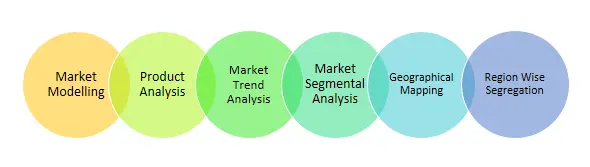
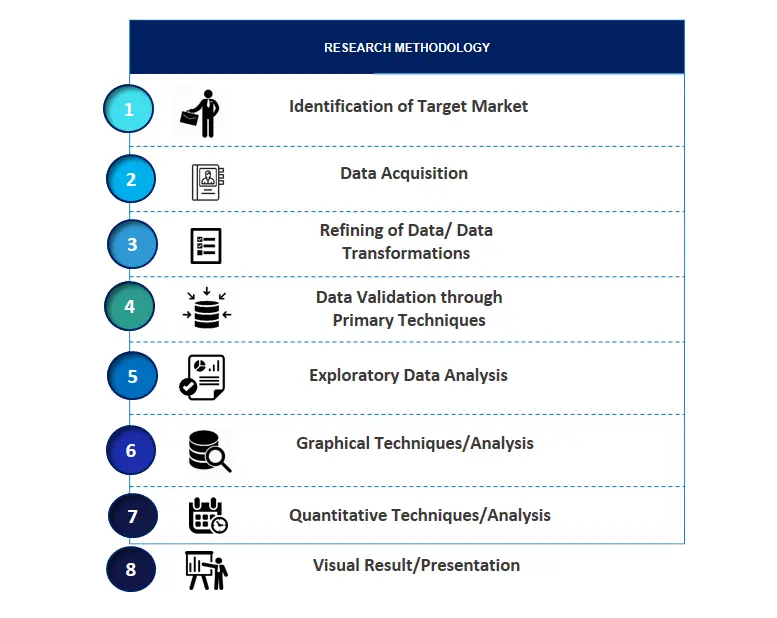
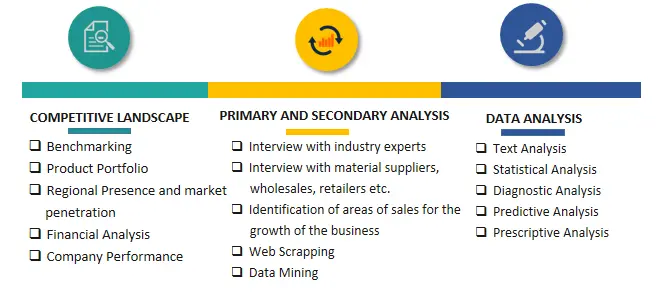
SPER Market Research’s methodology uses great emphasis on primary research to ensure that the market intelligence insights are up to date, reliable and accurate. Primary interviews are done with players involved in each phase of a supply chain to analyze the market forecasting. The secondary research method is used to help you fully understand how the future markets and the spending patterns look likes.

The report is based on in-depth qualitative and quantitative analysis of the Product Market. The quantitative analysis involves the application of various projection and sampling techniques. The qualitative analysis involves primary interviews, surveys, and vendor briefings.  The data gathered as a result of these processes are validated through experts opinion. Our research methodology entails an ideal mixture of primary and secondary initiatives.
SPER-Methodology-1

SPER-Methodology-2

SPER-Methodology-3


Frequently Asked Questions About This Report
The growth is driven by rising demand for precision farming, improved crop yields, cost efficiency, and the adoption of smart farming technologies worldwide.
Key technologies include machine learning, computer vision, IoT sensors, drones, and predictive analytics for crop monitoring, soil health, and resource optimization.
North America and Europe lead adoption due to advanced infrastructure and investment, while Asia-Pacific is rapidly growing with government support and agritech startups.
PLACE AN ORDER
  • 15 % off
     
    $ 4250
  • 20 % off
             
    $ 5650
  • 25 % off
         
    $ 7450
Pre-Purchase Inquiry
SEND AN INQUIRY
NEED CUSTOMIZATION?
Request Customization
CALL OR EMAIL US
US:
India:
Email:
100% Secure Payment

SPER American Express
SPER VISA
SPER Master Card
SPER Mestro
SPER Paypal
SPER CCAvenues

Have a glance of the Report

  Download Free Sample

Looking for Customization?

 Customization Request

Have a Question?

 Reach Our Analysis Team

COVID-19 impact analysis?

 Request Analysis
Thought Leadership

Trusted by Industry Leaders

Our data-driven insights have influenced the strategy of 200+ reputed companies across the globe.

SPER-Astellas Pharma
SPER-Microsoft
SPER-EY
SPER-McKinsey
SPER-Bain
SPER-Max-Healthcare
SPER-DHL
SPER-IQVIA
SPER-Mitsubishi Logistics
SPER-PACCOR
SPER-Macmillan Education
SPER-Kankar IMRB
SPER-ITA
SPER-PWC
SPER-SAPTCA
SPER-Straumann
SPER-Danaher
SPER-AandM
SPER-MENARINI Silicon Biosystems
SPER-IPSOS
SPER-Heineken
HIPPA Compliant
GDPR Certified
ISO 27001
Peer Reviewed
Get Started Today

Your Competitive Advantage in
Pharmaceutical & Medical Technology
Markets

Join industry leaders leveraging AI-powered intelligence to make confident, data-driven decisions that accelerate breakthrough treatments and technologies to market.

No Credit Card Required
15-Minute Demo
Expert Guidance