
1. Abstract
This study examines how robotics are reshaping hospital operations, clinical outcomes, and workforce dynamics. A structured primary survey was conducted with 100 hospital professionals, 50 from the United States and 50 from the European Union, to assess adoption levels, perceived benefits, challenges, and future expectations related to robotics in healthcare. Findings indicate strong perceived value in operational efficiency, surgical precision, and staff workload reduction, alongside concerns regarding cost, training, and system integration.
2. Research Objectives
The primary objectives of this study were to:
- Assess the current level of robotics adoption in hospitals
- Evaluate perceived clinical and operational impact
- Identify challenges and barriers to implementation
- Compare perspectives between US and EU respondents
- Understand future expectations for hospital robotics
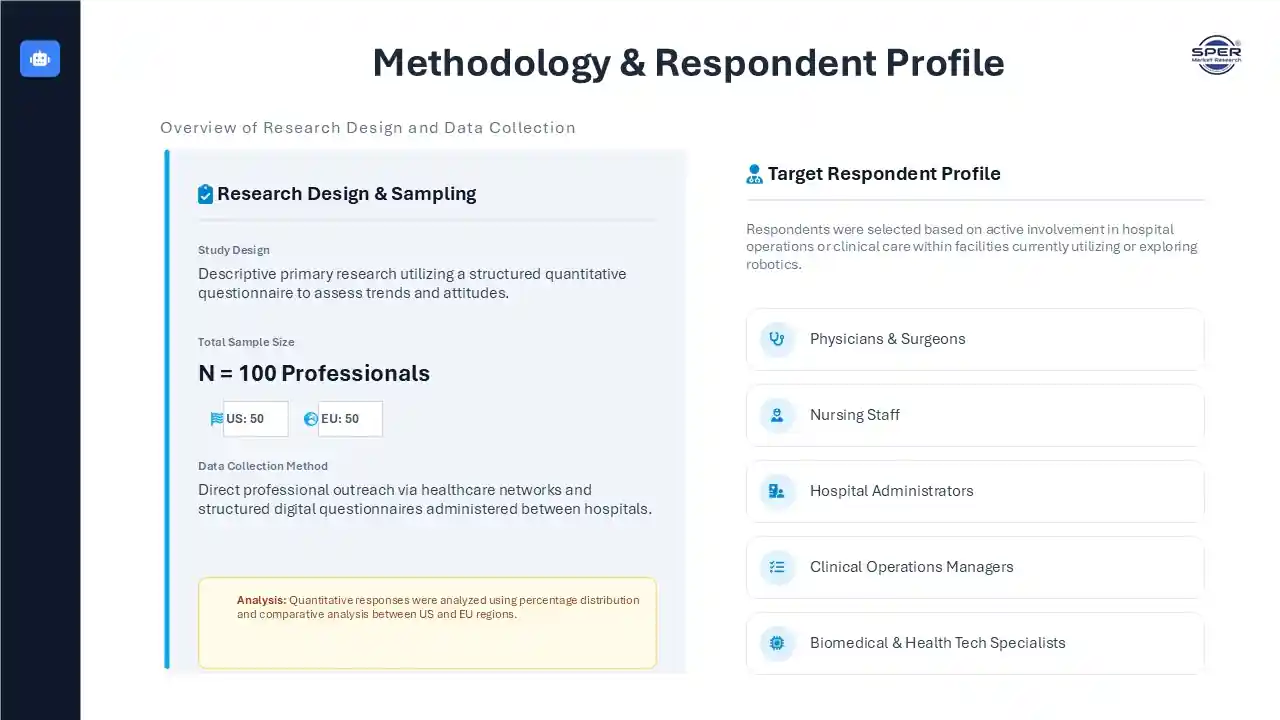
3. Methodology
3.1 Research Design
A descriptive primary research design using a structured questionnaire was employed.
3.2 Sample
- Total respondents: 100
- United States: 50 hospital professionals
- European Union: 50 hospital professionals
3.3 Respondent Profile
- Physicians and surgeons
- Nursing staff
- Hospital administrators
- Clinical operations managers
- Biomedical/health technology specialists
3.4 Data Collection
Responses were collected through direct professional outreach and structured digital questionnaires between hospitals.
3.5 Data Analysis
Quantitative responses were analyzed using percentage distribution and comparative analysis between regions.
4. Questionnaire and Findings
Q1. Does your hospital currently use robotic systems?
| Response | US (%) | EU (%) |
|---|---|---|
| Yes | 68 | 60 |
| Pilot phase | 20 | 26 |
| No | 12 | 14 |
Outcome: Robotics adoption is already mainstream in both regions, with higher maturity in US hospitals.
Q2. Which hospital areas use robotics most frequently?
| Area | US (%) | EU (%) |
|---|---|---|
| Surgery | 72 | 66 |
| Pharmacy & medication delivery | 48 | 54 |
| Logistics & material transport | 44 | 58 |
| Patient monitoring | 36 | 40 |
| Disinfection & sanitation | 52 | 62 |
Outcome: EU hospitals show stronger adoption in logistics and sanitation, while US hospitals lead in robotic surgery.
Q3. What is the primary benefit of robotics in your hospital?
| Benefit | US (%) | EU (%) |
|---|---|---|
| Improved precision & accuracy | 46 | 42 |
| Reduced staff workload | 30 | 36 |
| Operational efficiency | 18 | 16 |
| Patient safety | 6 | 6 |
Outcome: Precision and workload reduction are the dominant perceived benefits across both regions.
Q4. Has robotics improved patient outcomes?
| Response | US (%) | EU (%) |
|---|---|---|
| Significantly improved | 38 | 32 |
| Moderately improved | 42 | 46 |
| No noticeable change | 16 | 18 |
| Unsure | 4 | 4 |
Outcome: Over 80% of respondents in both regions report positive patient outcome improvements.
Q5. How has robotics impacted hospital staff?
| Impact | US (%) | EU (%) |
|---|---|---|
| Reduced physical strain | 44 | 48 |
| Improved job efficiency | 36 | 34 |
| Increased technical workload | 14 | 12 |
| No impact | 6 | 6 |
Outcome: Robotics primarily support staff well-being and productivity, with limited negative impact reported.
Q6. What are the main challenges in implementing robotics?
| Challenge | US (%) | EU (%) |
|---|---|---|
| High initial cost | 48 | 42 |
| Training requirements | 26 | 30 |
| Integration with existing systems | 18 | 20 |
| Regulatory concerns | 8 | 8 |
Outcome: Cost remains the leading barrier, particularly in US hospitals with decentralized funding models.
Q7. Are staff adequately trained to work with robotic systems?
| Response | US (%) | EU (%) |
|---|---|---|
| Yes | 54 | 58 |
| Partially | 34 | 30 |
| No | 12 | 12 |
Outcome: While most staff feel prepared, training depth remains an improvement area.
Q8. Do you believe robotics will reduce hospital operational costs long-term?
| Response | US (%) | EU (%) |
|---|---|---|
| Yes | 62 | 66 |
| No | 14 | 10 |
| Unsure | 24 | 24 |
Outcome: A strong majority expect long-term cost efficiency, despite high upfront investment.
Q9. How do patients respond to robotic technologies?
| Response | US (%) | EU (%) |
|---|---|---|
| Positive | 58 | 60 |
| Neutral | 30 | 28 |
| Negative | 12 | 12 |
Outcome: Patient acceptance is generally positive, with minimal resistance.
Q10. How will robotics change hospitals in the next 5–10 years?
| Expectation | US (%) | EU (%) |
|---|---|---|
| Standard across departments | 56 | 52 |
| Major support role | 32 | 36 |
| Limited niche use | 12 | 12 |
Outcome: Respondents expect robotics to become a core hospital infrastructure component.
5. Key Findings Summary
- Robotics adoption is already widespread in US and EU hospitals
- Surgical robotics dominate in the US; logistics and sanitation lead in the EU
- Clear improvements in efficiency, precision, and staff workload
- High costs and training remain key challenges
- Long-term optimism about financial and clinical impact
6. Conclusion
Robotics are fundamentally transforming hospital operations and care delivery. This primary research confirms that hospitals across the US and EU view robotics not as experimental tools, but as strategic assets. While financial and training barriers persist, the trajectory clearly points toward deeper integration, expanded use cases, and improved patient and staff outcomes.
7. Practical Implications
- Hospital leaders should prioritize training programs alongside technology investment
- Policymakers must align regulations with rapid technological advancement
- Vendors should focus on interoperability and cost scalability