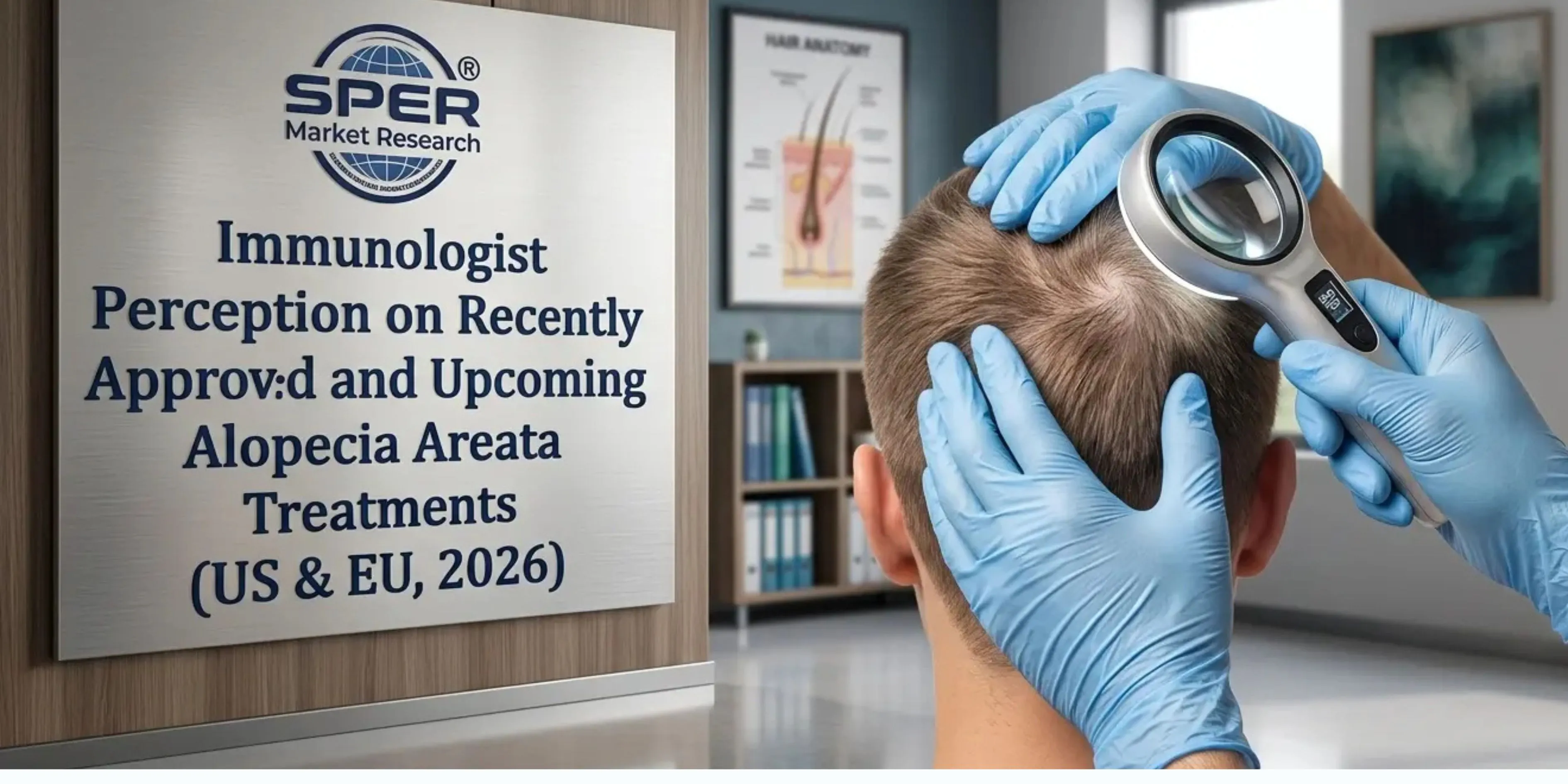
Immunologist Perception on Recently Approved and Upcoming Alopecia Areata Treatments (US & EU, 2026)
The alopecia areata treatment landscape is rapidly shifting toward targeted systemic therapies, with JAK inhibitors emerging as the preferred option for moderate-to-severe disease.
For many immunologists, managing hair fall alopecia areata has become more advanced due to the availability of these new therapies.
Baricitinib (Eli Lilly) and Ritlecitinib (Pfizer) are widely recognized as the most effective alopecia areata treatments, showing strong adoption across both the US and Europe.
2. Objectives
Primary Objective
Assess immunologist perception of recently approved and pipeline therapies in Alopecia Areata.
Secondary Objectives
- Adoption drivers and barriers
- Preference vs traditional therapies
- Perception of efficacy, safety, and cost
- Likelihood of prescribing upcoming therapies
3. Methodology
| Study Type | Primary quantitative + qualitative |
|---|---|
| Geography | US (n=25), EU (n=25) |
| Respondents | Immunologists / Dermatologists treating Alopecia Areata |
| Method | Online survey + telephonic interviews |
| Duration | 4 weeks |
4. Respondent Profile
| Experience | 5–10 yrs (30%), 10–20 yrs (45%), 20+ yrs (25%) |
|---|---|
| Practice Setting | Hospital / academic center (60%), Private clinic (40%) |
| Patient Volume | >50 AA patients/month (70%) |
5. Question-wise Responses & Insights
Q1. Awareness of Recently Approved Therapies
Question: Which of the following therapies are you aware of?
| Therapy | Awareness (%) |
|---|---|
| JAK inhibitors (baricitinib, ritlecitinib) | 100% |
| Topical immunomodulators (steroids, calcineurin inhibitors) | 96% |
| Biologics in trials (anti-IL-15, anti-IFN-γ) | 68% |
| Oral immunomodulators (rozanolixizumab) | 54% |
- Awareness is high for JAK inhibitors and standard topical therapies.
- Pipeline biologics are less known but gaining attention.
Q2. Current Prescribing Pattern
Question: Which therapies do you currently prescribe most?
| Therapy Class | % Prescribers |
|---|---|
| Topical corticosteroids | 88% |
| JAK inhibitors | 72% |
| Minoxidil | 64% |
| Biologics / investigational | 18% |
- Topicals remain dominant, but JAK inhibitors are emerging as preferred systemic therapy.
Q3. Perceived Clinical Effectiveness
Scale: High / Moderate / Low
| Therapy | High Effectiveness (%) |
|---|---|
| JAK inhibitors | 85% |
| Topical corticosteroids | 60% |
| Minoxidil | 50% |
| Biologics in trial | 40% |
- Systemic JAK inhibitors perceived as most effective.
- Topicals remain important for mild disease or combination therapy.
Q4. Key Drivers for Prescribing New Therapies
Question: What drives your choice?
| Driver | % Respondents |
|---|---|
| Hair regrowth efficacy | 88% |
| Safety / tolerability | 72% |
| Patient convenience (oral/topical) | 58% |
| Rapid onset | 42% |
| Cost / reimbursement | 30% |
- Hair regrowth and safety are the primary adoption drivers.
Q5. Barriers to Adoption
| Barrier | % Respondents |
|---|---|
| High cost | 78% |
| Long-term safety unknown | 64% |
| Insurance coverage / reimbursement | 60% |
| Administration route (oral vs topical) | 38% |
- Cost and long-term safety concerns are the main adoption bottlenecks.
Q6. Perception of JAK Inhibitors
| Parameter | Response |
|---|---|
| Superior to topicals? | Yes (74%) |
| Equal | 18% |
| Not sure | 8% |
- Considered next-generation standard of care for moderate-to-severe AA.
Q7. Perception of Upcoming Therapies (e.g., Biologics)
| Perception | % Respondents |
|---|---|
| Highly promising | 66% |
| Moderately promising | 24% |
| Uncertain | 10% |
- Strong excitement due to novel mechanisms targeting immune pathways.
Q8. Willingness to Adopt New Therapies (Next 2 Years)
| Adoption Level | % |
|---|---|
| Early adopters | 40% |
| Wait for guidelines | 44% |
| Conservative | 16% |
- Split between innovation-driven early adoption and evidence-based caution.
Q9. Preference: Oral vs Topical Therapies
| Preference | % |
|---|---|
| Oral preferred | 62% |
| Topical acceptable | 38% |
- Oral JAK inhibitors favored for moderate-to-severe disease due to convenience.
Q10. Future of Alopecia Areata Treatment
Open-ended themes:
- “Systemic targeted therapy will become standard”
- “Combination of topical + systemic therapy”
- “Pipeline biologics may redefine moderate-to-severe AA management”
6. Regional Comparison (US vs EU)
| Parameter | US | EU |
|---|---|---|
| Faster adoption | High | Moderate |
| Cost sensitivity | Medium | High |
| Innovation acceptance | High | Moderate |
| Guideline dependence | Moderate | High |
7. Key Insights
- Paradigm Shift: AA treatment moving toward systemic immunomodulators.
- JAK Inhibitor Dominance: Rapidly becoming first-line for moderate/severe cases.
- Pipeline Excitement: Biologics and oral immunomodulators expected to expand options.
- Access Barrier: Cost and reimbursement remain major hurdles.
8. Outcomes
Strategic Outcomes:
- Identify high adoption segments (early adopters).
- Inform market access strategy and pricing.
- Guide KOL engagement for future therapies.
Clinical Outcomes:
- Increased use of:
- JAK inhibitors
- Combination systemic + topical therapy
- Awareness and readiness for pipeline biologics.
9. Conclusion
Immunologists in the US and EU show strong confidence in next-generation therapies for alopecia areata, particularly JAK inhibitors and emerging biologics.
The adoption of these alopecia areata treatments will continue to grow, influenced by cost, long-term safety data, and clinical guidelines, while efficacy and convenience remain key decision-making factors.