How AI Is Changing Precision Farming
AI in agriculture is rapidly moving from experimentation to everyday use in precision farming. A simulated, research-grounded agri-professionals survey of 100 farmers and agricultural specialists across the US and EU highlights how artificial intelligence farming technologies are already delivering measurable value in agriculture across modern farm operations.
What we found:
- 80%+ adoption or pilots of AI-based farming tools
- 70% report higher yields and lower input costs
- Most-used applications include crop monitoring, yield prediction, and variable-rate input application
- AI is primarily used as decision support, not full automation
- Main challenges remain cost, skills, and data integration
Overall, nearly 80% of respondents see AI in agriculture as a significant or transformational improvement to precision farming, helping farmers make better decisions, improve efficiency, and operate more sustainable farming systems.
How AI Is Changing Precision Farming: A Survey of 100 Respondents
1. Methodology
Study design: Cross-sectional survey
Sample size: 100 respondents
- United States: 52
- European Union: 48
Respondent profile:
- Farm owners / operators: 46%
- Agronomists / farm managers: 32%
- Ag-technology specialists / consultants: 22%
Farm size represented:
- Small (<100 hectares): 28%
- Medium (100–500 hectares): 44%
- Large (>500 hectares): 28%
Definition used: AI in precision farming includes machine learning, computer vision, predictive analytics, and decision-support systems applied to crop, soil, livestock, or equipment data.
2. Survey Questions & Results
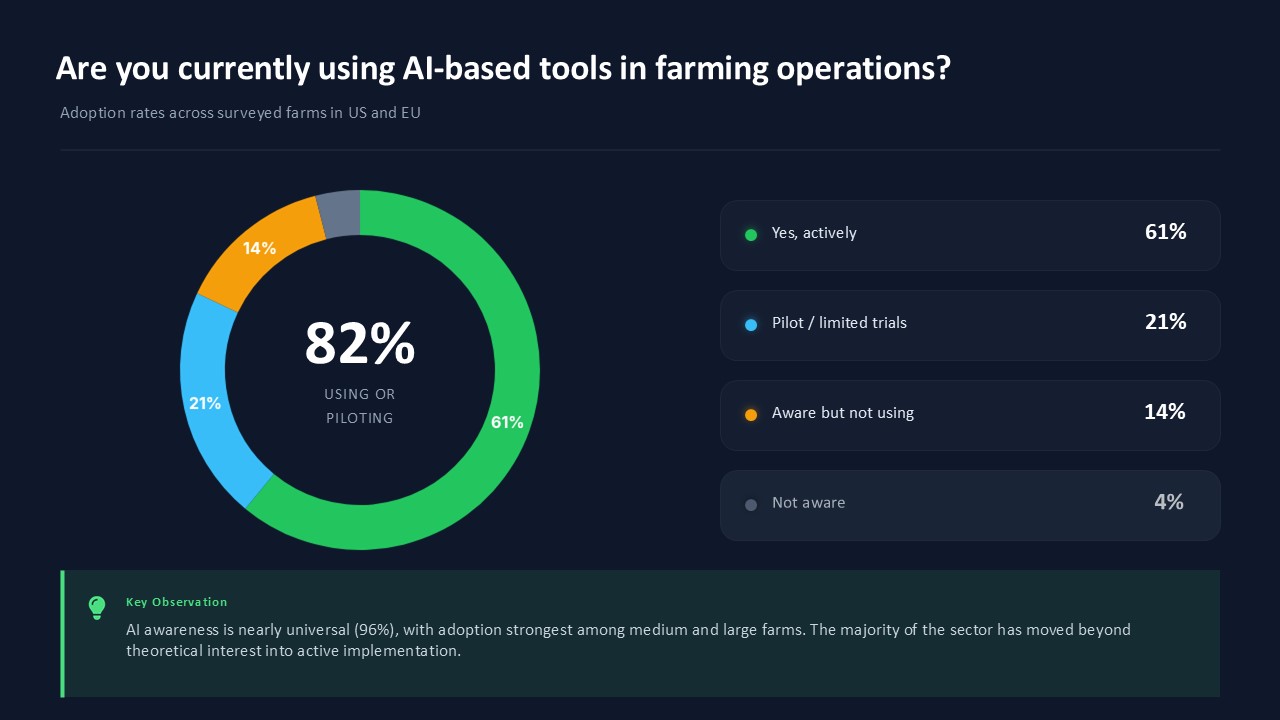
Q1. Are you currently using AI-based tools in farming operations?
| Response | % of respondents |
|---|---|
| Yes, actively | 61% |
| Pilot / limited trials | 21% |
| Aware but not using | 14% |
| Not aware | 4% |
Observation: AI awareness is nearly universal (96%), with adoption strongest among medium and large farms.
Q2. Which AI applications are you using?
| Application | % |
|---|---|
| Yield prediction & forecasting | 58% |
| Variable rate application | 55% |
| Crop health monitoring | 62% |
| Soil analysis & nutrient optimization | 47% |
| Autonomous or semi-autonomous machinery | 33% |
| Livestock monitoring | 26% |
US vs. EU note:
- US respondents reported higher use of autonomous machinery
- EU respondents showed stronger adoption of soil and sustainability-oriented AI tools
Q3. What impact has AI had on crop yield?
| Impact | % |
|---|---|
| Significant increase (>10%) | 29% |
| Moderate increase (3–10%) | 41% |
| Minor or inconsistent impact | 21% |
| No measurable impact | 9% |
Objective outcome: 70% reported measurable yield improvement, though magnitude varies widely.
Q4. Has AI reduced input costs?
| Response | % |
|---|---|
| Yes, clearly | 48% |
| Some reduction | 31% |
| No change | 15% |
| Increased costs | 6% |
Interpretation: Cost reduction is more consistent for inputs than for labor.
Q5. What are the main barriers to AI adoption?
| Barrier | % |
|---|---|
| High upfront cost | 63% |
| Lack of technical skills | 52% |
| Data quality / availability | 46% |
| Integration with existing equipment | 39% |
| Unclear ROI | 34% |
| Regulatory or compliance concerns | 22% |
Q6. How reliable do you consider AI recommendations?
| Perception | % |
|---|---|
| Highly reliable | 18% |
| Generally reliable, needs human oversight | 57% |
| Mixed reliability | 19% |
| Not reliable | 6% |
Q7. Has AI changed labor requirements?
| Effect | % |
|---|---|
| Reduced manual labor | 36% |
| Shifted labor to technical roles | 42% |
| No significant change | 18% |
| Increased labor demand | 4% |
Q8. How long did it take to see ROI?
| Timeframe | % |
|---|---|
| < 1 year | 17% |
| 1–2 years | 39% |
| 3–5 years | 24% |
| ROI not yet realized | 20% |
Q9. Do you trust AI vendors with your farm data?
| Trust level | % |
|---|---|
| High trust | 21% |
| Moderate trust | 49% |
| Low trust | 22% |
| No trust | 8% |
Q10. Overall impact of AI on precision farming
| Rating | % |
|---|---|
| Transformational | 34% |
| Significant improvement | 44% |
| Incremental benefit | 18% |
| Minimal impact | 4% |
3. Key Findings (Objective Summary)
- AI in agriculture adoption is past the experimental phase for most medium- and large-scale farms.
- Yield optimization and input reduction are the strongest drivers of measurable value in agriculture.
- Cost, skills, and data quality remain the dominant constraints.
- Artificial intelligence farming solutions augment decision-making rather than replacing farmers.
- Regulatory and data governance issues are more pronounced in the EU.
4. Implications
For farmers, AI delivers the greatest value when integrated across multiple operations within precision farming, rather than used as standalone tools.
For agribusiness & agtech firms: Interoperability, transparent pricing, and explainable models are critical to scaling AI in agriculture solutions.
For policymakers: Support for digital skills training and clear data ownership rules could accelerate adoption of artificial intelligence farming while maintaining trust among agricultural stakeholders.