
HCP Attitudes Toward Radioligand Therapy (RLT) Adoption in the US
Insights from 50 Healthcare Providers
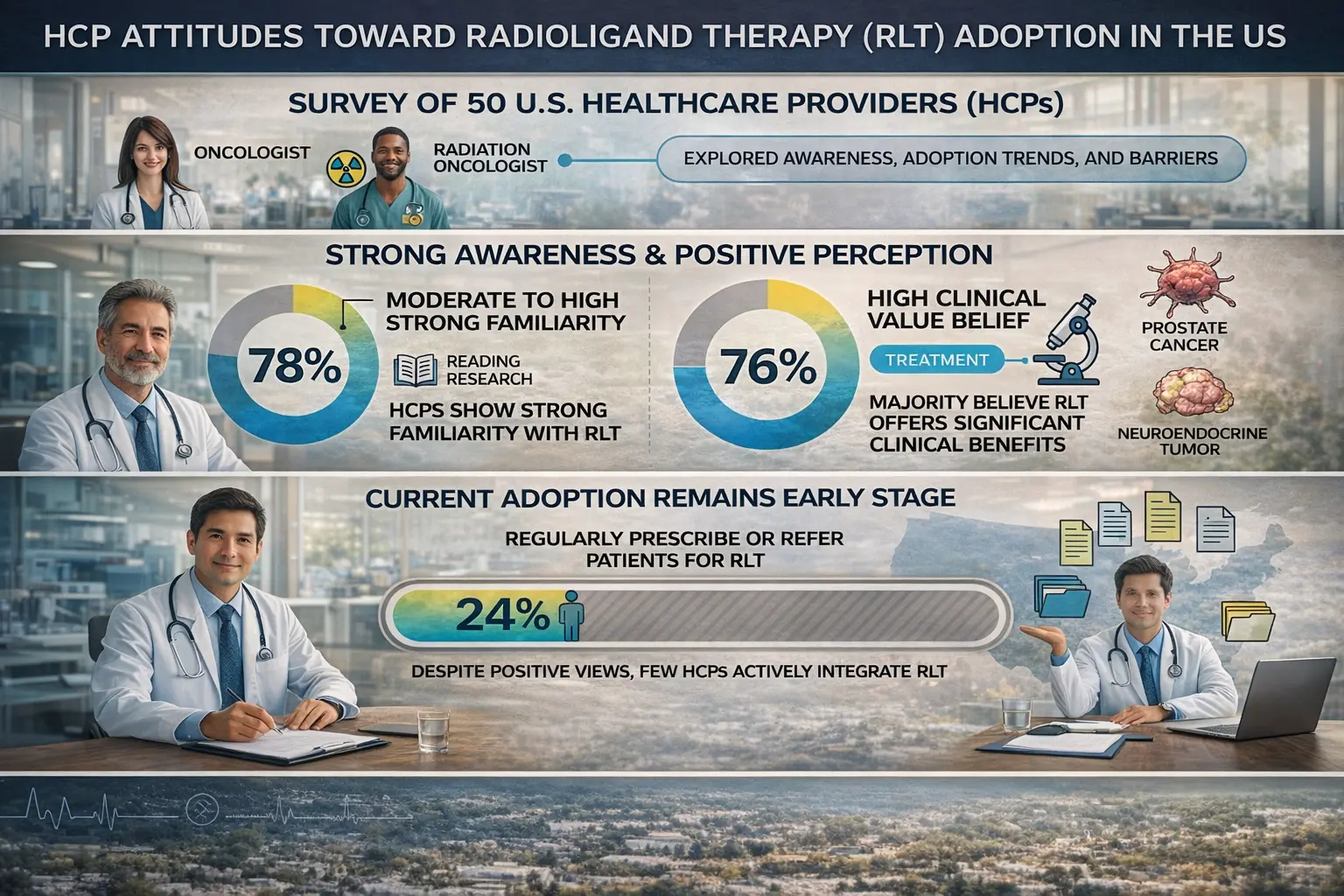
Radioligand therapy (RLT) is gaining momentum as an innovative treatment in precision oncology. A survey of 50 U.S. healthcare providers (HCPs)—including oncologists, nuclear medicine specialists, and radiation oncologists—explored awareness, adoption trends, and barriers to implementing RLT in clinical practice.
Survey results show strong awareness and positive perception of RLT. About 78% of respondents reported moderate to high familiarity, and 76% believe RLT provides high clinical value, particularly in treating prostate cancer and neuroendocrine tumors. However, real-world adoption remains in an early stage, with only 24% of HCPs regularly prescribing or referring patients for RLT.
The study also highlights key barriers to wider adoption. Limited treatment infrastructure (56%), reimbursement challenges (52%), and complex referral pathways (40%) were identified as the most significant obstacles preventing broader use.
Despite these challenges, the outlook for radioligand therapy is highly positive. Eighty percent of surveyed healthcare providers expect RLT utilization to increase over the next five years, driven by expanding clinical evidence, improved reimbursement pathways, and greater investment in nuclear medicine infrastructure.
Respondent Profile
- Medical Oncologists: 22
- Nuclear Medicine Physicians: 10
- Radiation Oncologists: 9
- Urologists: 6
- Haematologist-Oncologists: 3
Practice Setting
- Academic centers – 40%
- Community hospitals – 36%
- Private oncology clinics – 24%
Experience
- 10 years – 28%
- 5–10 years – 34%
- <5 years – 38%
Survey Results (Question-by-Question)
Q1. Awareness of Radioligand Therapy (RLT)
| Response | Respondents | % |
|---|---|---|
| Very familiar | 18 | 36% |
| Somewhat familiar | 21 | 42% |
| Heard of it but limited knowledge | 9 | 18% |
| Not familiar | 2 | 4% |
Q2. Current Experience Prescribing/Referring RLT
| Response | Respondents | % |
|---|---|---|
| Regularly prescribe/refer | 12 | 24% |
| Occasionally prescribe/refer | 17 | 34% |
| Rarely prescribe/refer | 14 | 28% |
| Never prescribed | 7 | 14% |
Q3. Perceived Clinical Value of RLT
| Response | Respondents | % |
|---|---|---|
| Very high value | 20 | 40% |
| High value | 18 | 36% |
| Moderate value | 10 | 20% |
| Low value | 2 | 4% |
Q4. Key Barriers to Adoption
| Barrier | Mentions | % |
|---|---|---|
| Limited treatment infrastructure | 28 | 56% |
| Reimbursement challenges | 26 | 52% |
| Referral logistics | 20 | 40% |
| Lack of training/expertise | 18 | 36% |
| Patient eligibility constraints | 15 | 30% |
Q5. Most Promising Indications
| Indication | Mentions | % |
|---|---|---|
| Prostate cancer | 34 | 68% |
| Neuroendocrine tumors | 29 | 58% |
| Breast cancer | 14 | 28% |
| Lung cancer | 12 | 24% |
| Other solid tumors | 9 | 18% |
Q6. Likelihood to Increase RLT Use
| Response | Respondents | % |
|---|---|---|
| Very likely | 23 | 46% |
| Likely | 17 | 34% |
| Neutral | 7 | 14% |
| Unlikely | 3 | 6% |
Q7. Infrastructure Availability
| Response | Respondents | % |
|---|---|---|
| Fully available | 16 | 32% |
| Partially available | 18 | 36% |
| Limited | 11 | 22% |
| None | 5 | 10% |
Q8. Key Drivers for Adoption
| Driver | Mentions | % |
|---|---|---|
| More clinical trial data | 30 | 60% |
| Clear reimbursement pathways | 28 | 56% |
| Expanded indications | 22 | 44% |
| Physician training programs | 19 | 38% |
| Improved supply/logistics | 16 | 32% |
Overall Key Findings
- Strong Clinical Enthusiasm: 76% of HCPs view RLT as high value therapy.
- Adoption Still Early: Only 24% regularly prescribe RLT.
- Structural Barriers: Infrastructure, reimbursement, referral complexity.
- Growth Expected: 80% anticipate increased RLT use.
- Priority Indications: Prostate cancer, Neuroendocrine tumors.