
AI in Surgical Robotics Systems: Primary Research Analysis (US & EU)
1. Research Objective
The primary objective of this study is to evaluate how AI in surgical robotics is reshaping surgical robotics systems across clinical, operational, and strategic dimensions, with a comparative lens on the US and EU healthcare ecosystems. The study also examines the broader role of AI in healthcare, particularly how technologies such as surgical augmentation and intelligent surgical partners are enhancing precision, decision-making, and surgical outcomes in modern operating environments.
Specific objectives include:
- Understanding current levels of AI adoption in surgical robotics
- Identifying key AI-driven functionalities influencing surgical outcomes
- Evaluating perceived benefits and risks of AI integration
- Measuring regional differences (US vs EU) in adoption, regulation, and trust
- Assessing future expectations for AI-enabled surgical robotics
2. Research Design & Methodology
- Study Type: Primary, descriptive research
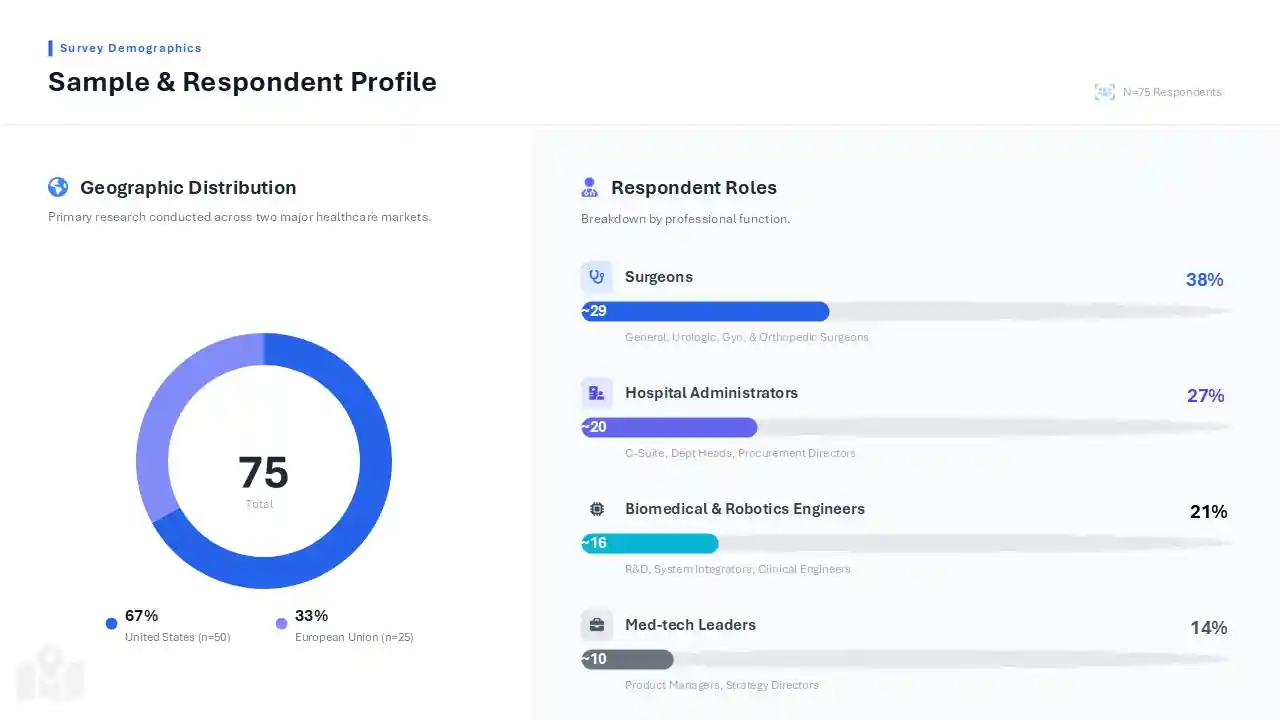
- Sample Size: 75 respondents
- United States: 50
- European Union: 25
- Respondent Profile:
- Surgeons (38%)
- Hospital administrators / decision-makers (27%)
- Biomedical / robotics engineers (21%)
- Med-tech product & strategy leaders (14%)
- Data Collection Method: Structured online questionnaire
- Analysis Type: Quantitative (percentage distribution) + qualitative interpretation
3. Key Outcomes (Executive Summary)
- AI is transitioning from experimental to decision-support and automation augmentation.
- The US leads in adoption speed, while the EU emphasizes governance and safety.
- Surgeons value AI for precision, visualization, and error reduction—not autonomy.
- Trust and explainability remain major barriers to full AI integration.
- AI is expected to shift surgical robotics from tool-centric to intelligence-centric platforms within 5–7 years.
4. Survey Results: Question-by-Question Analysis
Q1. Current Level of AI Integration
Interpretation: Most systems operate at moderate AI integration, focusing on augmentation rather than autonomy. EU respondents show slightly lower advanced adoption due to regulatory caution.
Q2. Most Valuable AI Capabilities
Interpretation: AI is valued primarily for enhancing surgeon capability. Visual intelligence remains the most impactful use case.
Q3. Impact on Surgical Outcomes
Interpretation: AI’s strongest contributions are precision and error reduction, while patient recovery improvements are still emerging.
Q4. Effect on Surgeon Workflow
Interpretation: AI improves ergonomics but increases cognitive load, especially in the EU due to stricter explainability requirements.
Q5. Primary Concerns
Interpretation: EU respondents show higher concern around regulation and explainability, reflecting a precautionary adoption model.
Q6. Influence on Purchasing Decisions
Interpretation: AI is a major differentiator but not the sole driver—cost, training, and vendor support remain essential.
Q7. Acceptable Level of Autonomy
Interpretation: Human-in-the-loop models are strongly preferred. Full autonomy is widely rejected.
Q8. Expected Role of AI in the Next 5 Years
Interpretation: AI will advance decision support, personalization, and semi-autonomous execution—not fully autonomous surgery.
5. Conclusion
This research highlights the pivotal role of AI in surgical robotics in evolving surgical robotics systems from mechanical precision tools into intelligent surgical partners within the broader landscape of AI in healthcare.
- Safety over speed
- Surgical augmentation over autonomy
- Explainability over black-box intelligence
While the US prioritizes innovation velocity, the EU focuses on governance and trust—creating two distinct yet complementary adoption pathways.