How AI Is Transforming Life Science Analytical Instruments: Insights from a US Survey
Artificial intelligence (AI life science) is increasingly redefining how analytical instruments are designed, operated, and used across the life sciences industry. To understand the current level of adoption and its practical impact, a survey of 50 professionals across the United States—including scientists, laboratory managers, engineers, and business leaders—was conducted. The study provides US survey insights on adoption levels, use cases, benefits, challenges, and expectations for the future, offering a snapshot of how AI transformation is reshaping analytical workflows today.
The primary objective of the study was to assess how extensively laboratory AI adoption has occurred in life science analytical instruments and to identify the areas where it delivers the most value. Additional goals included understanding operational benefits, barriers to implementation, and the timeline respondents expect for AI transformation to become a mainstream capability across laboratories.
AI Adoption Levels
Survey results indicate strong momentum toward laboratory AI adoption:
- 48% reported AI is fully implemented
- 30% are in pilot or partial deployment
- 22% have not yet adopted AI
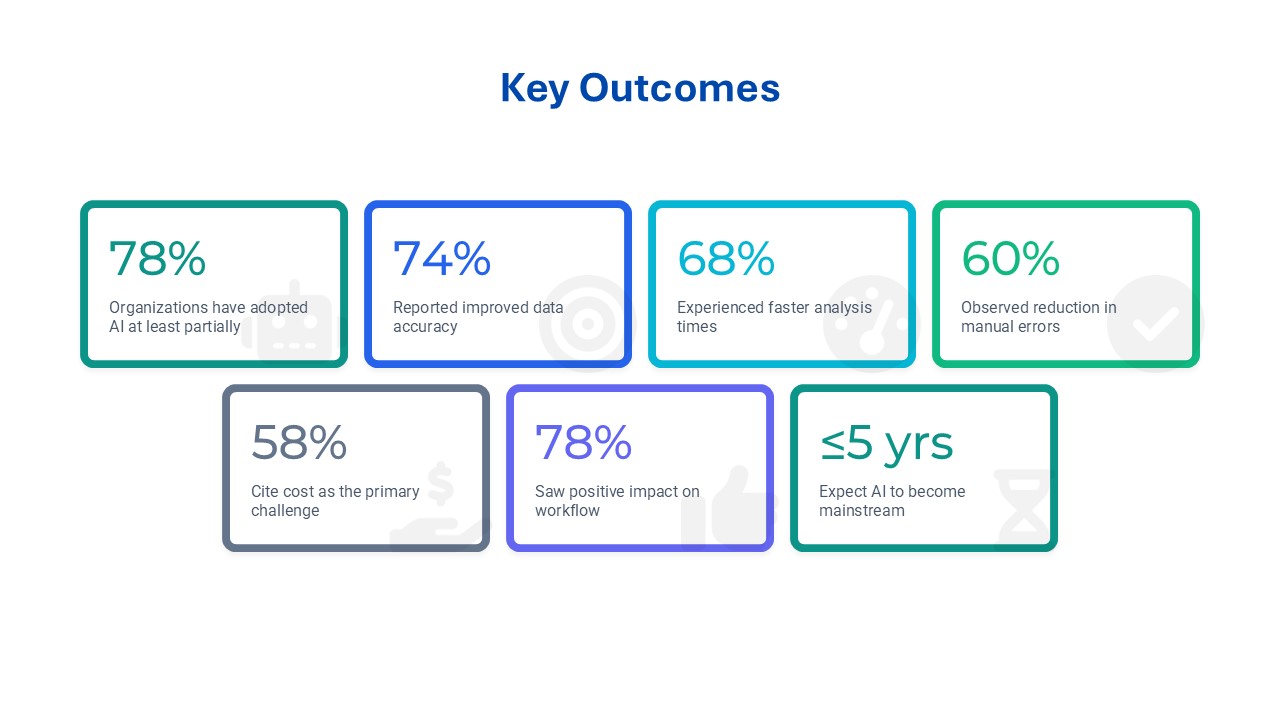
Overall, 78% of organizations are already engaging with AI in some capacity, highlighting a shift from experimentation to operational integration.
AI Use Cases in Analytical Instruments
AI is being applied across multiple analytical instrument workflows, with data-centric applications leading adoption:
- Automated data interpretation – 68%
- Predictive maintenance – 52%
- Adaptive experiment optimization – 44%
- Real-time error detection – 38%
- Pattern & anomaly recognition – 36%
- Remote monitoring & diagnostics – 30%
Benefits of AI Adoption
Respondents reported substantial improvements after implementing AI life science technologies:
- Improved data accuracy – 74%
- Faster analysis & turnaround – 68%
- Reduced manual errors – 60%
- Lower operational costs – 48%
- Better regulatory compliance – 42%
Impact on Laboratory Workflows
- Significant improvement – 42%
- Moderate improvement – 36%
- No change – 14%
- Negative impact – 8%
Overall, 78% reported a positive effect on daily operations.
Barriers to AI Adoption
- High implementation cost – 58%
- Lack of skilled personnel – 52%
- Integration challenges – 46%
- Data privacy & cybersecurity concerns – 38%
- Limited trust in AI decisions – 32%
Future Expectations
Respondents expressed strong confidence in AI transformation:
- AI mainstream in 1–2 years – 32%
- Within 3–5 years – 46%
- Longer timeline – 18%
- Never mainstream – 4%
overall, 78% expect laboratory AI adoption to be a standard feature within five years.
Summary
AI life science is rapidly transitioning from an emerging capability to a foundational component of life science analytical instruments. With clear gains in accuracy, speed, automation, and operational efficiency, adoption is accelerating despite challenges related to cost, skills, and system integration. As technology matures, AI transformation and laboratory AI adoption are expected to become the norm across US laboratories.