
AI in Healthcare: US vs Europe Survey
1. Study Objective
Primary objective:
To assess how AI solutions in clinical and non-clinical hospital practices are changing care quality, efficiency, and workforce experience in hospitals in the US and Europe, based on responses from 100 frontline professionals.
This study contributes to a broader AI adoption in healthcare survey perspective by examining real-world hospital use cases, workforce experiences, and operational outcomes across healthcare systems.
Secondary objectives:
- Compare hospital AI adoption trends between US and European hospitals.
- Identify perceived benefits (diagnostic accuracy, time savings, cost efficiency, patient experience).
- Identify key barriers (data quality, integration, regulation, trust, skills).
- Explore differences between clinical staff (physicians, nurses, allied health) and non-clinical staff (administration, IT, operations).
- Examine key stakeholders in AI in healthcare, including clinicians, administrators, and hospital IT teams involved in implementation and oversight.
2. Methods – How your 100-respondent survey could look
- Design: Cross-sectional online survey designed to understand real-world AI adoption in healthcare across hospitals in the United States and Europe.
-
Sample:
- N = 100 hospital professionals
- 60 from the US, 40 from Europe (e.g., EU + UK, Switzerland)
- 65% clinical roles, 35% non-clinical/administrative/IT
- Respondents included clinicians, administrators, and technology leaders involved in evaluating or implementing hospital AI systems.
- Key sections in the questionnaire:
- Demographics & role (country, hospital type, role, years of experience).
-
AI exposure & adoption:
- “Does your hospital currently use AI in clinical care?” (Yes/No)
- “In which areas is AI used?” (diagnostic imaging, triage, CDSS, documentation, scheduling, billing, supply chain, bed management, chatbots, etc.)
- Some hospitals also reported early deployments of conversational AI in healthcare workflows, particularly for documentation assistance, patient communication, and administrative automation.
-
Perceived impact (5-point Likert scale, then collapsed into positive/neutral/negative):
- Diagnostic accuracy
- Time to diagnosis / throughput
- Administrative workload
- Patient experience & access
- Staff burnout
- Barriers & risks (data quality, bias, explainability, regulation, cost, IT integration, training). These factors are often discussed in relation to the broader pros and cons of AI in healthcare adoption within hospital systems.
- Future outlook (likelihood of increasing AI use in next 3–5 years), including expansion into areas such as automation, decision support, and AI predictive analytics in healthcare.
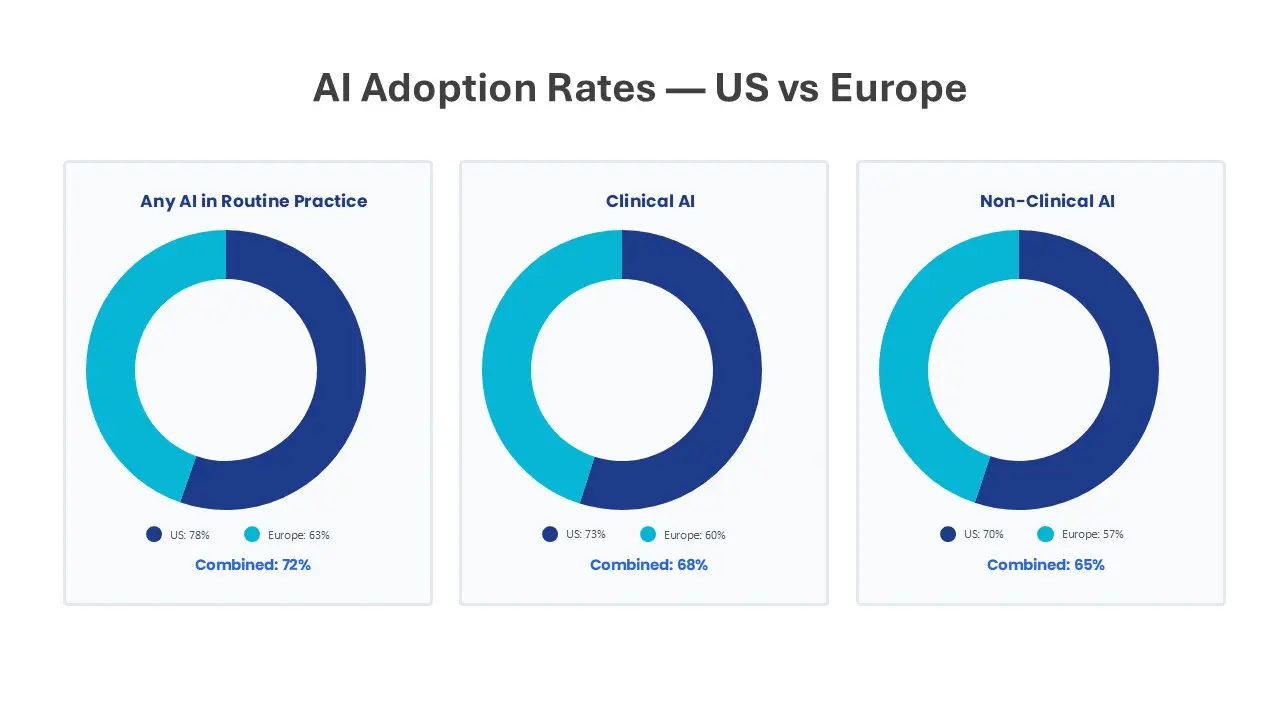
3. Example Outcomes with Data (Illustrative)
3.1 Respondent profile & adoption
Table 1. Respondent profile and AI adoption (N = 100)
| Characteristic | Overall (N=100) | US (n=60) | Europe (n=40) |
|---|---|---|---|
| Clinical roles (physicians, nurses, etc.) | 65% | 63% | 68% |
| Non-clinical (admin, IT, operations, finance) | 35% | 37% | 32% |
| Hospital uses any AI in routine practice | 72% | 78% | 63% |
| Uses clinical AI (diagnostics, CDSS, etc.) | 68% | 73% | 60% |
| Uses non-clinical AI (admin/ops/finance) | 65% | 70% | 57% |
These findings highlight evolving AI adoption trends in areas such as imaging diagnostics, administrative automation, and operational management.
Top clinical AI use-cases (among hospitals using clinical AI)
- Radiology / imaging decision support (e.g., triage, detection, quantitative reporting): 74%
- Clinical decision support (risk scores, sepsis alerts, treatment suggestions): 59%
- Pathology / lab interpretation: 41%
- Triage / ED prioritization: 37%
Top non-clinical AI use-cases (among hospitals using non-clinical AI)
- Appointment scheduling & no-show prediction: 61%
- Billing & coding automation / denial management: 54%
- Bed management & patient flow prediction: 46%
- Supply chain & inventory optimization: 33%