AI's Role in Diagnostics and POC Testing Survey
Study Overview
A primary research survey was conducted with 100 professionals across the diagnostic industry AI ecosystem, including pathologists, radiologists, lab managers, healthcare administrators, and industry executives. The objective was to understand the current role of AI in diagnostics and its expected AI impact on POC testing. The study also explores how healthcare AI technologies are shaping the future of Point-of-Care testing and decentralized diagnostics.
Key Findings
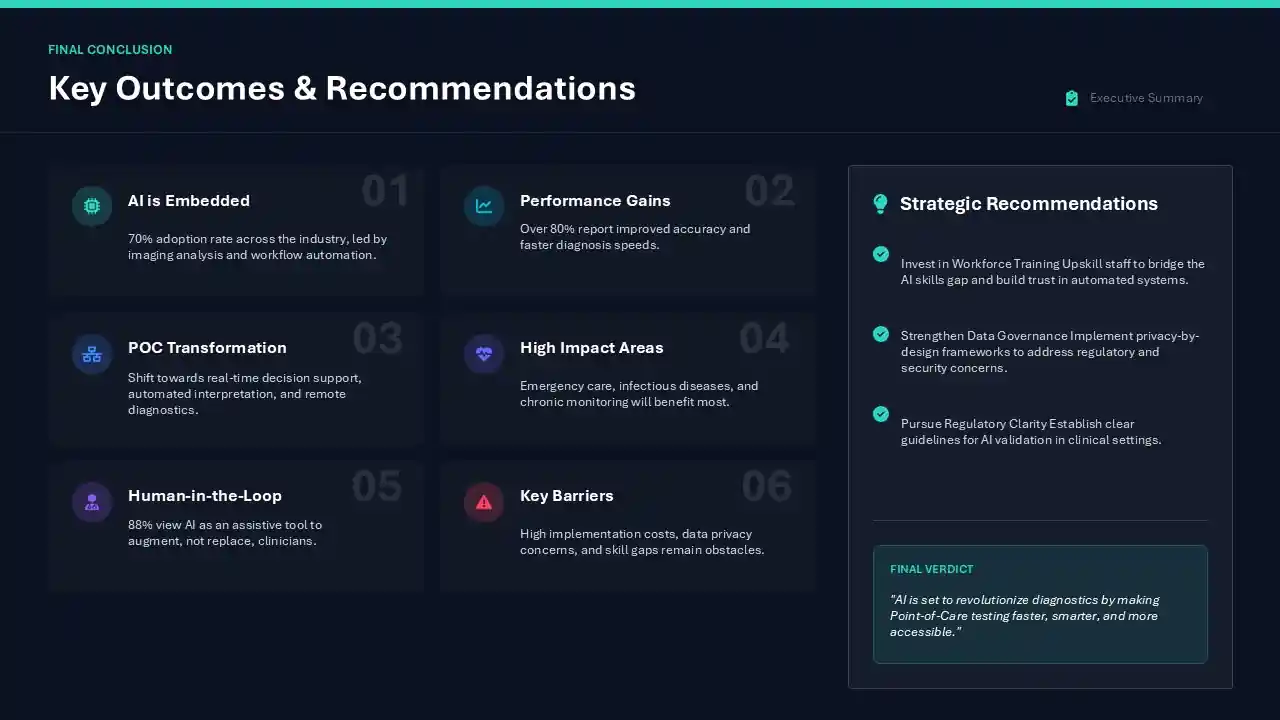
- 70% of respondents already use AI in diagnostics in some part of their diagnostic workflow.
- 86% believe AI will significantly or moderately increase point-of-care testing adoption.
- 83% reported moderate to significant improvements in diagnostic accuracy using healthcare AI tools.
- 88% believe AI will augment clinicians rather than replace them.
- 76% expect AI to become mainstream in diagnostics within the next five years.
Current Use of AI
AI is most widely used in medical imaging, pathology slide analysis, workflow automation, predictive analytics, and quality control. Respondents highlighted faster turnaround time, improved accuracy, and reduced human error as the primary benefits of AI in diagnostics across modern healthcare environments.
Impact on Point-of-Care Diagnostics
- Real-time decision support at the bedside
- Automated result interpretation
- Remote diagnostics and telemedicine integration
- Reduced reliance on centralized laboratories
- Early disease detection through predictive analytics
Areas with Highest Impact
- Emergency and critical care
- Infectious disease testing
- Chronic disease monitoring
- Bedside imaging and rapid screening
Challenges to Adoption
- Lack of skilled AI professionals
- High implementation costs
- Data privacy and cybersecurity concerns
- Regulatory and compliance issues
Conclusion
The study confirms that AI in diagnostics is rapidly becoming a core enabler of faster, more accurate, and decentralized diagnostics. For Point-of-Care testing, healthcare AI will deliver intelligent support directly to clinicians, enabling real-time decisions and broader access to quality care. AI will not replace diagnosticians, but it will redefine how, where, and how fast diagnosis happens across the evolving diagnostic industry AI ecosystem.